No Visa, No Crowds, No Fences
Here's the pitch, stripped down to what actually matters: no visa application, no long lines of safari trucks jockeying for the same lion sighting, and no fences separating you from a wilderness so vast it dissolves into the Kalahari sands rather than any ocean. Botswana's Okavango Delta is one of the last great wild places on Earth built, quite deliberately, to stay that way — and for U.S. passport holders, getting there requires paperwork you can handle in five minutes at the airport, not a consulate visit.
This is not the safari of the nature documentaries shot in the Maasai Mara, with a dozen vehicles ringing a single leopard kill. Botswana chose a different path decades ago, and it shows in every part of the experience — from the price tag to the silence. Let's be upfront about that trade: this is a premium, remote trip, not a budget one. If you go in expecting Kenya-on-a-shoestring, you'll be disappointed. If you go in understanding you're paying for exclusivity and access most travelers never get, the Delta delivers something genuinely rare.
A Delta That Never Reaches the Sea
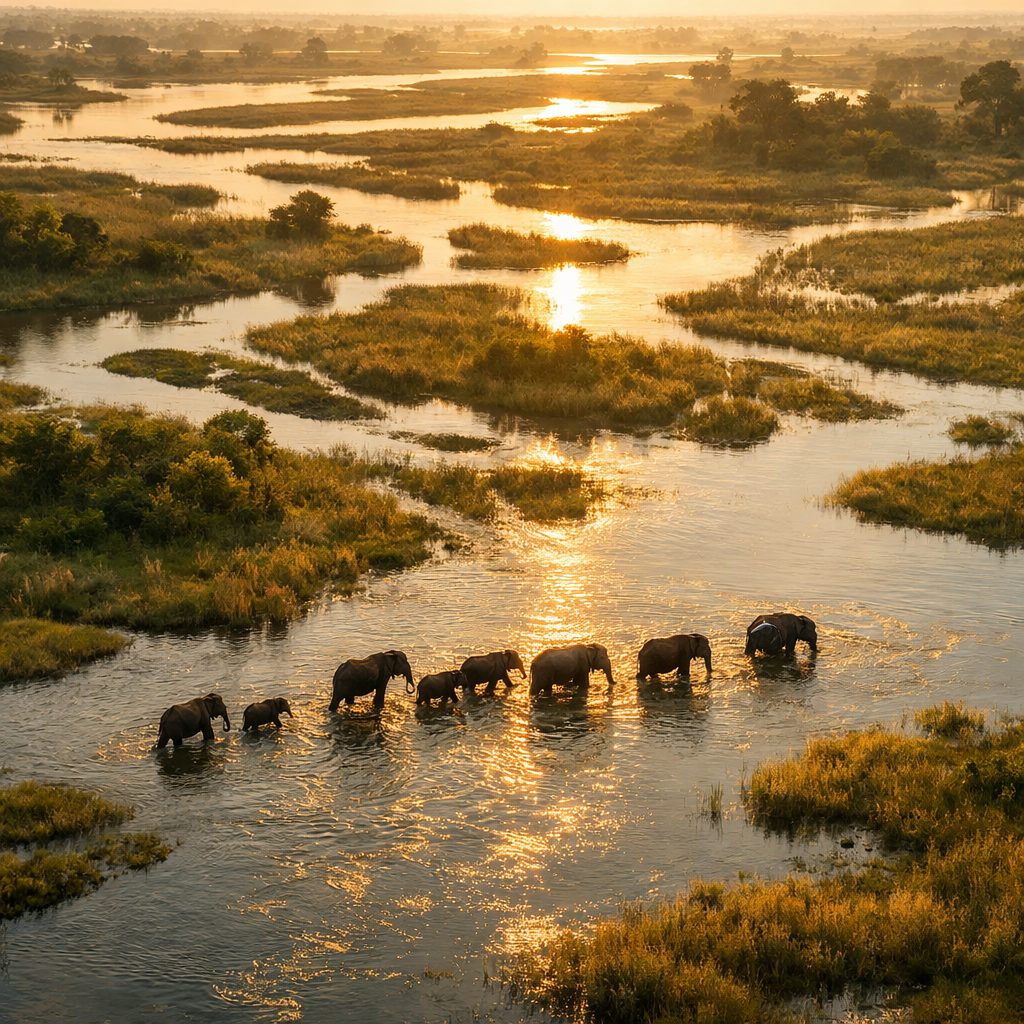
Most deltas on the planet are river endings — the place where fresh water finally meets an ocean. The Okavango does something stranger. Water falls as rain in the Angolan highlands, flows south through Namibia's Caprivi Strip, and pours into the flat basin of northern Botswana — where it simply stops, spreading out across roughly 6,000 square miles of channels, lagoons, and papyrus-lined islands before evaporating and soaking into the Kalahari Desert sands. It is one of the very few major interior (or "endorheic") delta systems in the world that never reaches a sea or ocean at all.
UNESCO recognized the Okavango Delta as a World Heritage Site in 2014, citing exactly this rarity — a functioning inland delta ecosystem, still almost entirely intact, supporting one of Africa's densest concentrations of wildlife. There's a further quirk that catches first-time visitors off guard: the annual flood pulse arrives during Botswana's dry winter months, not the rains. Water that fell in Angola months earlier arrives in the Delta between roughly May and August, meaning the landscape is often at its most flooded and lush precisely when the rest of the region is parched — concentrating animals around the permanent waterways in spectacular fashion.
The Low-Volume, High-Value Model — and Why It Costs More Than Kenya or Tanzania
Since its 1990 national tourism policy, Botswana has deliberately steered away from mass-market safari tourism in favor of a "low-volume, high-value" strategy: fewer beds, higher nightly rates, and strict limits on camp size and vehicle density inside concession areas. In practice, this means:
- Small camps. Most Delta camps hold somewhere between 6 and 18 guests total — a fraction of the bed count at comparable East African lodges.
- Private concessions, not shared reserves. Many camps operate inside exclusive traversing areas, so you won't encounter vehicles from a dozen other lodges at the same sighting.
- Off-road, night-drive, and walking privileges that are heavily restricted or banned in Kenya's and Tanzania's public reserves are often permitted in Botswana's private concessions, because there simply isn't the vehicle traffic to manage.
The trade-off is cost. Where a mid-range Kenyan safari lodge might run $150–$300 a night, premium all-inclusive Okavango camps commonly start around $400 a night per person and climb well beyond $1,000 at the top end — all-inclusive of meals, game drives or mokoro (dugout canoe) outings, and often the light-aircraft transfer itself. That is the honest headline: this is a splurge trip and a remoteness trip, not a backpacker add-on to a broader Southern Africa itinerary. Travelers weighing the Delta against Kenya's Maasai Mara or Tanzania's Serengeti (see our Maasai Mara guide for that comparison) should think of Botswana as the quieter, pricier, more exclusive sibling — smaller crowds and wilder access, at a materially higher price per night.
When to Go
The dry season, roughly May through October, is peak Okavango season for good reason: vegetation thins out, animals cluster around permanent water channels, and malaria risk drops. It's also, unsurprisingly, peak-price season, with July through September commanding the highest camp rates and earliest booking windows (six to twelve months out for the best camps).
Shoulder months — April/early May and November — can offer meaningfully lower rates, lusher green scenery, and excellent bird life, at the cost of higher humidity, occasional rain, and slightly less concentrated game viewing. If budget flexibility matters more than guaranteed peak wildlife density, ask operators directly about shoulder-season packages; discounts of 20–30% off peak rates are not unusual.
Getting There: Maun and the Bush Plane
There's no road that drops you at your camp door. Almost every Okavango Delta lodge is reached via Maun, Botswana's small but busy safari-gateway airport, which receives regional flights from Johannesburg, Cape Town, Victoria Falls, and Windhoek. From Maun, a light-aircraft charter — typically a 5- to 12-seat bush plane — ferries guests directly to a private airstrip inside the Delta, often just minutes' drive from camp.
Budget roughly $1,500–$1,700 for international flights from major U.S. gateways to the region (usually routing through Johannesburg), plus camp-arranged charter transfers that most operators bundle into the overall package price rather than billing separately. Because charter seats are limited and shared among guests heading to multiple camps, book your Delta dates as a package through your camp operator or a specialist safari agent rather than trying to freelance the logistics.
Where to Stay: Camp Price Tiers
Premium All-Inclusive ($400–$700/night per person)
Solid, well-run tented camps with private guides, shared or small-group game drives, and full board. This is the realistic entry point for most first-time Delta visitors.
Luxury ($700–$1,200/night per person)
Larger suites or villas, private plunge pools, more flexible activity scheduling, and often a private guide-and-vehicle arrangement rather than shared drives.
Ultra-Luxury ($1,200+/night per person)
Fully private concessions, dedicated butler service, photographic-hide access, and the most exclusive traversing rights in the Delta — the tier where you may not see another vehicle for days.
Nearly all tiers operate on an all-inclusive model: accommodation, meals, drinks, twice-daily game activities, and laundry are typically bundled, which makes budgeting more predictable than a la carte travel.
What to See and Do
- Mokoro excursions — silent, poled dugout-canoe rides through the reed-lined channels, often the most memorable few hours of the entire trip.
- Game drives targeting the Delta's dense elephant population, plus lion, leopard, African wild dog, buffalo, and abundant antelope species.
- Walking safaris, permitted in many private concessions, offering a ground-level read of tracks, dung, and bird calls impossible to get from a vehicle.
- Moremi Game Reserve, the Delta's core protected area and one of the richest wildlife zones in Africa, combining permanent water with dry mopane woodland.
- Scenic flights over the Delta's braided channels — often included as part of the charter transfer, and worth requesting a window seat for.
Practical Logistics
Visa: U.S. citizens do not need a visa for tourist stays of up to 90 days within any 12-month period — among the more traveler-friendly entry policies in the region. Note that visas cannot be obtained on arrival for those who do need one (e.g., certain non-U.S. nationalities or temporary-passport holders), so double-check requirements for your specific passport before flying.
Health: The Delta is a malaria zone; consult a travel clinic about prophylaxis well before departure, and pack repellent and long sleeves for dawn and dusk activities.
Emergency numbers: Botswana runs separate emergency lines — 999 for police, 992 for ambulance, and 998 for fire. In practice, in the remote Delta, your camp's guides and radio network are your fastest first line of response; most premium camps carry medical evacuation insurance coordination as standard.
Currency and language: The Botswana Pula (BWP) is the local currency, though most camps price and bill in U.S. dollars. English is the official language alongside Setswana, and camp staff are almost universally fluent English speakers.
Budget reality: Plan for this as a splurge trip. A realistic five-night Delta itinerary at a premium camp, plus international flights, commonly lands in the $4,000–$7,000-per-person range all-in. That number is the honest floor for doing the Delta properly — it is not a trip to try to do cheaply, and operators who promise otherwise are usually cutting corners on concession quality or camp size.
Book the Delta
The Okavango Delta rewards travelers willing to pay for scarcity — scarcity of crowds, scarcity of vehicles, scarcity of noise. It's the safari built for people who've already done the bucket-list version elsewhere and want the version with no one else in the frame. Start planning early: the best camps and charter seats book out six to twelve months ahead of the May–October peak.
✈️ Book Your Botswana Safari Now →*Affiliate links — BTN may earn a commission at no extra cost to you.