A Frontier Story Most Travelers Never Hear
Say "Black history and travel" and most people picture Ghana's coast, Harlem's brownstones, or the Deep South's civil rights trail. Almost no one pictures Alaska. That's the gap Black Alaska fills — a real, documented, and largely uncelebrated history of whalers, soldiers, and homesteaders who were building lives on America's last frontier more than 150 years ago.
This isn't a stretch of history or a footnote dressed up for a headline. Black whalers were working the waters off Alaska's panhandle in the 1840s. An all-Black Army unit kept the peace during the Klondike Gold Rush. And a Black woman from Montgomery, Alabama became the Alaska Territory's first Black attorney and first Black female homesteader. It's a story that belongs on the map — and Anchorage and Juneau are where you go to find it.
The Whalers Who Came First (1840s)
Long before the Gold Rush and long before statehood, Black sailors were already in Alaskan waters. Whaling crews out of New England — among the most integrated workplaces in 19th-century America, since ship captains cared far more about a sailor's skill than his race — hunted the Gulf of Alaska and the waters off the southeast panhandle starting in the 1840s. That makes Black whalers among the very first Americans of any background to reach this part of the world, decades before the United States even purchased Alaska from Russia in 1867. Some crew members jumped ship, traded, or stayed on in Tlingit territory around Sitka and the panhandle, laying down a Black presence in the region that predates almost every other chapter of American Alaska.
Company L: The Buffalo Soldiers of the Klondike Gold Rush
Fast-forward to 1899. Gold fever has emptied ships full of prospectors into the boomtowns of Skagway and Dyea, the trailheads for the brutal Chilkoot Pass route to the Klondike goldfields. Lawlessness follows the gold. The U.S. Army's answer was Company L of the 24th United States Infantry — one of the Army's storied Buffalo Soldier regiments — which landed at Dyea on May 20, 1899, replacing the 14th Infantry and becoming one of the first U.S. military units stationed in Alaska.
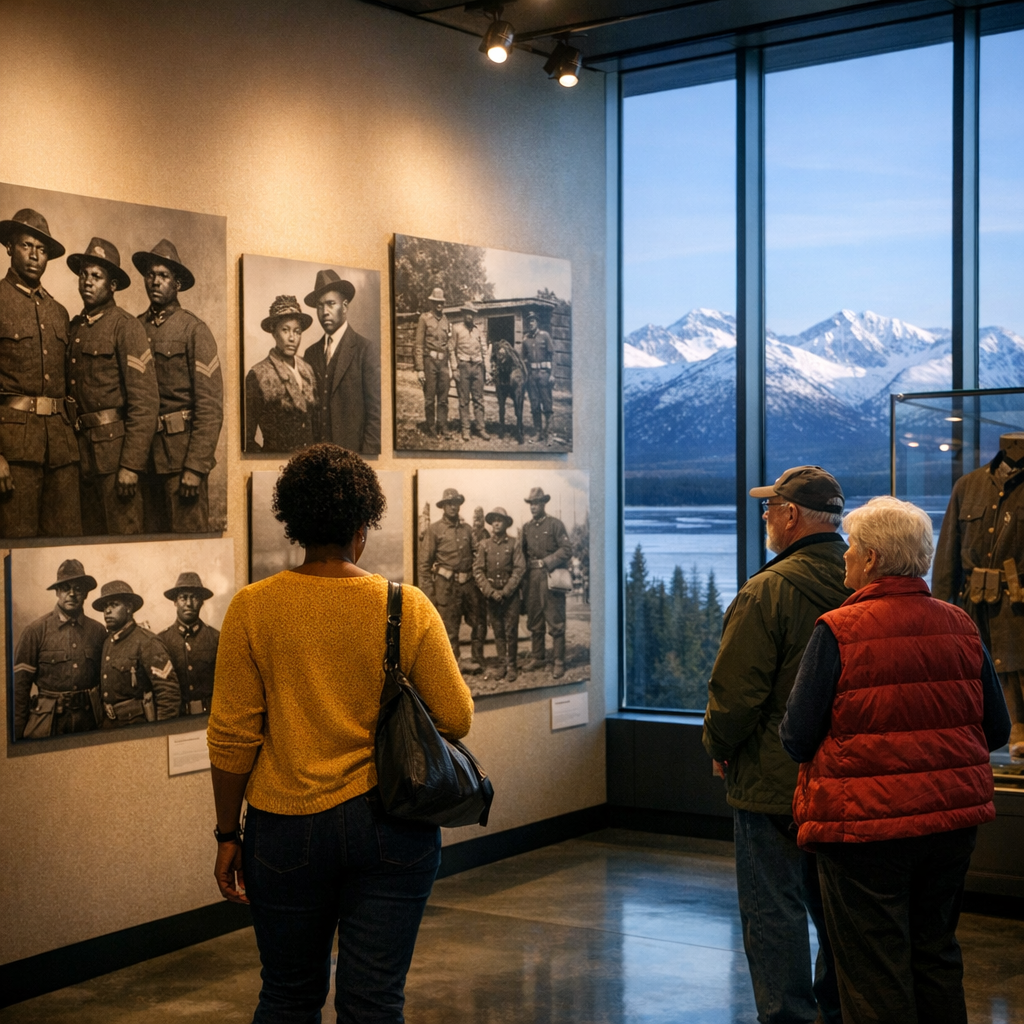
Roughly 112 Black soldiers under Captain Henry Walter Hovey spent nearly three years keeping order in the gold rush chaos: breaking up gunfights, running fire patrols through brutal winters, escorting deserters back to their ships, and even helping the towns survive the disastrous Skagway River flood of 1901. They stood in for American authority during a tense border dispute with Canada, working alongside Canadian officials, and navigated fraught relations between prospectors and the Tlingit people whose homeland this was. Off duty, the soldiers fielded a baseball team, attended church, and marched in Fourth of July parades — even as Skagway's YMCA moved to segregate them, a bitter reminder that service didn't buy equality. Most of Company L completed their enlistments and shipped out to Fort Missoula, Montana by early 1902, but for a few frontier years, Black soldiers were the law in Alaska's most famous gold rush towns.
Mahala Ashley Dickerson: From Montgomery to the Last Frontier
Six decades later, another barrier fell. Mahala Ashley Dickerson (1912–2007) grew up in Montgomery County, Alabama, where she attended the Montgomery Industrial School for Girls alongside a young Rosa Parks. She graduated cum laude from Fisk University in 1935, then Howard University School of Law in 1948 — one of only four women in her class — and that same year became the first African American woman admitted to the Alabama state bar. She later became the second Black woman admitted to practice in Indiana.
A 1958 vacation to Alaska changed everything. Dickerson relocated permanently with her three sons, and in 1959 became the Alaska Territory's first Black attorney. She staked a 160-acre homestead outside Anchorage, becoming Alaska's first Black female homesteader, then built a law practice that took on some of the earliest equal-pay lawsuits filed on behalf of women university professors anywhere in the country. In 1983 she became the first Black president of the National Association of Women Lawyers, and in 1995 the American Bar Association named her a Margaret Brent Women Lawyers of Achievement honoree. She practiced law into her nineties before her death in 2007 at age 94 — a homesteader and a barrier-breaker in the same lifetime.
Where to Start: The Anchorage Museum
The Anchorage Museum (625 C Street, downtown Anchorage) is the natural first stop for tracing this history — its collections and past exhibitions have documented Alaska's Black whalers, Buffalo Soldiers, homesteaders, and civil rights history (including the founding of Alaska's first NAACP chapter in Anchorage in 1951) in real depth. General admission runs about $20.
An honest heads-up: the museum's widely cited "Black Lives in Alaska: Journey, Justice, Joy" exhibition ran from April 2021 to February 2022 and has since closed — it was a temporary exhibition, not a permanent gallery. As of this writing we could not confirm that it or an equivalent Black history exhibit is currently on display. Before you build a trip around it, check the Anchorage Museum's current exhibits page or call ahead. Even without that specific show running, the museum's Alaska history and Alaska Native galleries, research library, and staff are still the best-informed starting point in the state for this story, and rotating exhibitions do return.
Getting to Anchorage and Juneau
Fly into Ted Stevens Anchorage International Airport (ANC) — Alaska's main air gateway, with direct flights from Seattle, Portland, Denver, Minneapolis, and other West Coast hubs. Juneau is a separate leg entirely: there is no road connecting Alaska's two largest cities, so plan on a roughly 90-minute Alaska Airlines flight from Anchorage to Juneau International Airport (JNU), or work Juneau into an Alaska Marine Highway ferry route or cruise itinerary, which is how many travelers experience the panhandle and the Skagway/Dyea gold rush sites in the same trip.
Once you're on the ground, a rental car earns its keep in Anchorage — useful for the museum, day trips toward Seward and the Kenai Peninsula, and covering a spread-out city. Skip the rental in Juneau; downtown and the waterfront are walkable, and taxis and ride-share fill in the gaps. If your itinerary includes Skagway or Dyea to stand where Company L actually served, that's typically a day cruise, ferry hop, or small-plane leg from Juneau.
Best Time to Visit & Budget
May through September is the sweet spot — long daylight hours, open museum hours, accessible hiking, and ferry and cruise schedules running at full tilt. Winter travel is possible but logistically harder and colder, with shorter museum and attraction hours.
Budget roughly $150–300 per day once flights are booked, covering mid-range lodging, meals, the $20 museum admission, and a rental car or in-town transport. Add several hundred dollars for the Anchorage–Juneau flight or ferry leg, and more if Skagway/Dyea is on your list.
BTN Insider Tips
Call the museum before you fly. Exhibitions on Black Alaskan history have run before and will likely run again, but confirm what's actually on the walls during your travel dates.
Pair the history with the geography. Standing in Skagway or Dyea, where Company L served, adds a dimension the museum alone can't — budget the extra travel day if you can.
Book the Anchorage–Juneau leg early. Flights and ferry space tighten up fast in peak summer months.
Layer up even in summer. Alaska's "warm season" still runs cool and changeable; pack for rain and wind regardless of the calendar.
Book Your Alaska Trip
This is a frontier history that deserves to be seen, not just read about. Start in Anchorage, cross to Juneau, and trace a story of whalers, soldiers, and one remarkable homesteader-lawyer that most of the country still doesn't know.
✈️ Book Your Alaska Trip Now →*Affiliate links — BTN may earn a commission at no extra cost to you.