A Church That Still Stands, A Story That Still Matters
On a quiet downtown block in Birmingham, Alabama, a red-brick church with twin towers holds one of the most important and painful stories in American history — and one of its most redemptive. The 16th Street Baptist Church is not a museum. It is an active, living congregation that still holds Sunday service in the same sanctuary where, on September 15, 1963, a bomb planted by Klansmen took the lives of four young girls: Addie Mae Collins, Denise McNair, Carole Robertson, all 14, and Cynthia Wesley, 11. Addie's older sister, Sarah Collins, survived the blast in the church basement but lost an eye.
Their deaths, on a Sunday morning during Youth Day services, did not happen in isolation. They happened four months after this same church had served as the staging ground for the Birmingham Children's Crusade — and they happened because of what that crusade had already accomplished. Today, the church, the Birmingham Civil Rights Institute directly across the street, and Kelly Ingram Park beside it form a single walkable block that traces how a Sunday-school bombing and a movement built by schoolchildren changed the country. For Black travelers, this is not a stop to rush through. It is ground to walk slowly and with intention.
The Children's Crusade: When Birmingham's Kids Marched First
By the spring of 1963, adult-led protests against Birmingham's segregation laws had stalled. Organizers with the Southern Christian Leadership Conference, including the Reverend Martin Luther King Jr. and the Reverend Fred Shuttlesworth, faced dwindling numbers of adults willing to risk arrest and their livelihoods. So on May 2, 1963, the movement made an unprecedented decision: it turned to the city's children.
Students ranging from elementary school age to college age gathered at 16th Street Baptist Church, then walked out of its doors in waves toward downtown Birmingham to demand the desegregation of public facilities. More than 1,000 children marched that first day. City police arrested hundreds and packed them into jail cells and paddy wagons built for a fraction of that number. When the marches continued the following day, Commissioner of Public Safety Eugene "Bull" Connor ordered fire hoses turned on the child demonstrators — water pressure strong enough to strip bark from trees and tear clothing from bodies — and unleashed police dogs on them as well.
Photographs and television footage of children being blasted off their feet by fire hoses and lunged at by police dogs ran in newspapers around the world within days. The images did what years of organizing had struggled to do: they made Birmingham's brutality impossible for the rest of the country, and the world, to look away from. Within days, the city agreed to begin desegregating downtown businesses. President Kennedy would later cite the Birmingham images as part of what pushed him toward proposing the legislation that became the Civil Rights Act of 1964.
September 15, 1963: The Bombing
The children's victory in Birmingham was met, four months later, with terrorism. Just before 11 a.m. on September 15, 1963, a bomb planted beneath a stairwell on the church's east side detonated as Sunday school was letting out and the congregation was preparing for the 11 o'clock service, whose sermon that day was to be titled "The Love That Forgives." The blast tore through the basement ladies' lounge, where five girls had gathered. Four of them — Addie Mae Collins, Denise McNair, Carole Robertson, and Cynthia Wesley — were killed. Their names deserve to be spoken, and remembered, whenever this history is told.
More than 8,000 mourners attended their funerals. Dr. King eulogized them as "the martyred heroines of a holy crusade for freedom and human dignity," and their deaths, following so closely on the fire hoses and dogs turned on their classmates, became a turning point in American public opinion. It took decades for justice to catch up to the crime: Klansman Robert Chambliss was convicted in 1977, Thomas Blanton in 2001, and Bobby Frank Cherry in 2002. A fourth suspect, Herman Cash, died in 1994 without ever being charged.
Visiting 16th Street Baptist Church Today
The church still worships every Sunday, and it still welcomes visitors from around the world who want to understand this history at its source. Guided interior tours are offered Tuesday through Saturday, with tour hours generally beginning at 10 a.m. and the last tour starting at 3 p.m., though hours can shift around church events and holidays. Advance scheduling is required and can be arranged through the church's official online booking system or by calling the church office directly for group visits of 40 or more. Tour admission is modest — roughly $10 for adults and $5 for students 18 and under — and a typical visit runs about an hour. Because this is a working church rather than a static museum, always confirm current tour availability before you arrive, especially around anniversaries, holidays, and civic commemorations when the schedule may change.
Birmingham Civil Rights Institute
Directly across the street from the church sits the Birmingham Civil Rights Institute, a Smithsonian-affiliated museum that opened in 1992 to tell the fuller story of Birmingham's role in dismantling Jim Crow. Its multimedia exhibitions walk visitors through the daily indignities of segregated life in Birmingham, the strategy and courage behind the local movement, and an oral history archive that preserves firsthand accounts from people who lived through the marches, the arrests, and the bombing. The Institute regularly hosts traveling Smithsonian exhibitions alongside its permanent galleries, and it anchors what is now recognized, alongside the church and the park, as part of the Birmingham Civil Rights National Monument — designated by President Obama in January 2017 to protect and interpret four downtown blocks of this history in perpetuity.
Kelly Ingram Park's Sculpture Trail
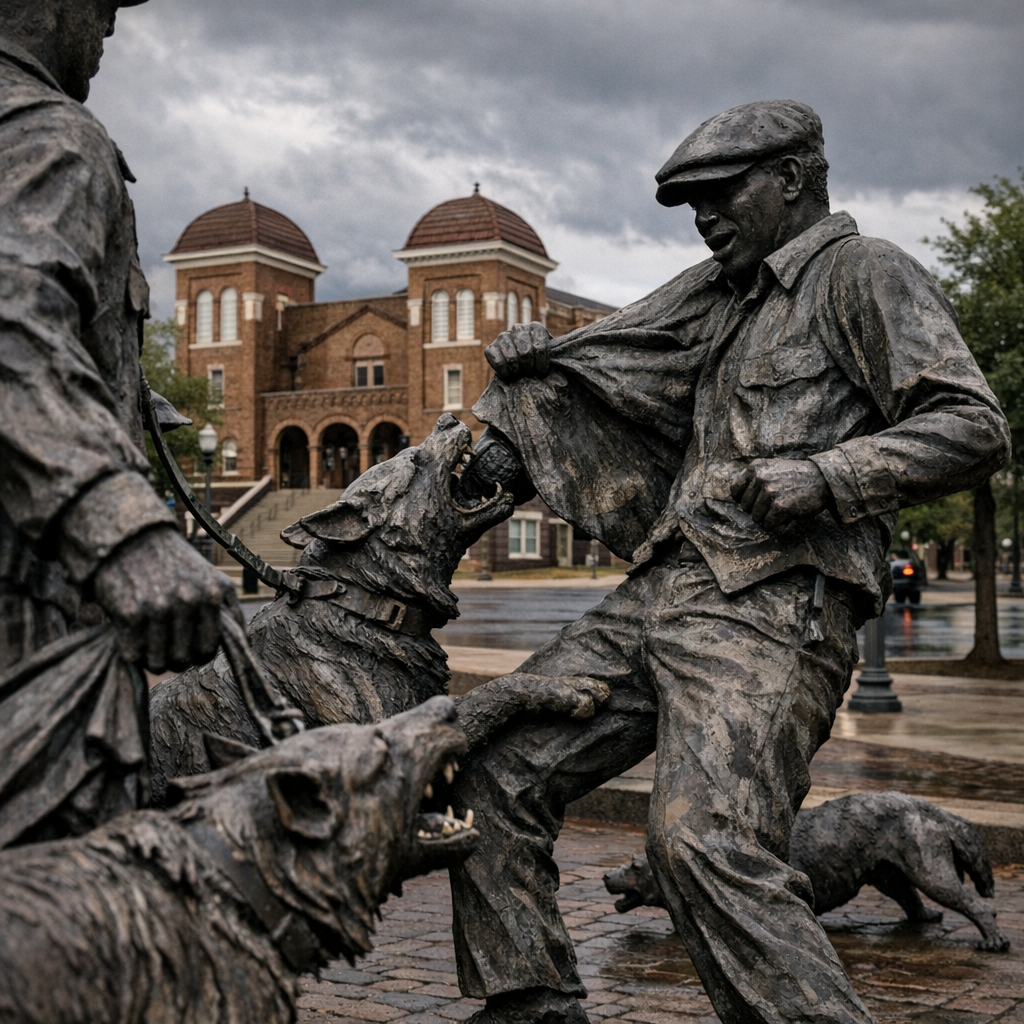
Between the church and the Institute sits Kelly Ingram Park, the very ground where the 1963 confrontations played out. What was once a staging area for marches and a site of violent police response is now a quiet, contemplative memorial landscape. A walking path circles the park's perimeter, lined with sculptures and interpretive markers that confront visitors directly with the events of that spring. Among the most striking is a bronze sculpture by artist Ronald S. McDowell, dedicated in 1995, depicting a teenage boy being lunged at by a police dog — a direct memorial to the young marchers of the Children's Crusade. Other installations and an audio tour throughout the park describe the fire hoses and dog attacks unleashed on child protesters on May 7, 1963, situating visitors inside the geography of the events rather than simply reading about them from a distance.
Walking the park's path, with the church's brick towers visible on one side and the Institute's modern facade on the other, is a genuinely different experience than reading this history in a textbook. Give yourself unhurried time here. Many visitors find the park's stillness, more than any single exhibit, is where the weight of what happened truly settles in.
Making the Most of a Visit
- Start at the Institute. Its exhibitions provide the historical context that makes the church and the park land with their full significance.
- Book your church tour in advance. This is an active congregation, not a facility on standby for tourists — confirm your date and time through the official booking channel before you travel.
- Walk the park slowly. The sculpture trail is designed to be experienced on foot, at a contemplative pace, not photographed in passing.
- Pair it with the wider Alabama civil rights trail. Birmingham sits about an hour from Montgomery's Legacy Museum, the National Memorial for Peace and Justice, and Dexter Avenue Baptist Church, and roughly two hours from Selma's Edmund Pettus Bridge, making a multi-day civil rights itinerary through Alabama entirely feasible.
- Visit Bethel Baptist Church and the A.G. Gaston Motel. Both sites played direct roles in the Birmingham campaign and are a short drive or rideshare from the downtown district.
- Be prepared for an emotional visit. Many Black travelers describe this district as one of the most moving stops on any civil rights itinerary. There is no wrong way to feel here.
Where to Eat and Stay
Birmingham's downtown core has a strong roster of hotels within a short drive of the Civil Rights District, from the historic Redmont Hotel to modern chain properties near the convention district. After a morning spent at the church, Institute, and park, Birmingham's celebrated barbecue scene — built on its signature white sauce — and classic meat-and-three restaurants offer a warm, welcome grounding. Niki's West is a beloved local institution for soul food classics, and downtown's Fourth Avenue Historic Business District, once the commercial heart of Black Birmingham, is worth a walk of its own.
🏨 Book Birmingham Hotels →Getting There and Getting Around
Birmingham-Shuttlesworth International Airport (BHM) — itself named for civil rights leader Fred Shuttlesworth — offers direct flights from major hubs including Atlanta, Charlotte, Dallas, and Washington D.C., and sits about 15 minutes from downtown. The Civil Rights District itself is entirely walkable: the church, the Institute, and the park all sit within the same city block. A rental car or rideshare is useful for reaching related sites elsewhere in the city, and for continuing on to Montgomery or Selma as part of a broader Alabama pilgrimage.
✈️ Find Birmingham Flights →Best Time to Visit
Spring (March through May) and fall (September through November) offer Birmingham's mildest, most walkable weather, with temperatures generally in the 60s and 70s. September carries particular weight for visitors, as the anniversary of the bombing on September 15 often brings commemorative events and services to the church and district. Summers in Birmingham are hot and humid; winters are mild but can bring occasional cold snaps.
BTN Verdict
Birmingham's Civil Rights District asks something different of visitors than most destinations do: not entertainment, but attention. The 16th Street Baptist Church still stands and still worships. The Birmingham Civil Rights Institute still teaches. Kelly Ingram Park still remembers, sculpture by sculpture, the children who marched into fire hoses so the rest of the country could no longer look away. Addie Mae Collins, Denise McNair, Carole Robertson, and Cynthia Wesley did not live to see the changes their deaths helped bring about. Walking this block, slowly and with respect, is one way travelers can carry their names forward.
*Affiliate links — BTN may earn a commission at no extra cost to you.