The Real Bermuda Isn't the Pink Sand — It's the Beat
Everyone comes to Bermuda for the pink sand beaches, and fair enough — Horseshoe Bay's blush-colored shoreline earns every postcard it's ever been on. But if you leave the island having only photographed the sand, you've missed the thing that actually makes Bermuda unlike anywhere else on earth: the Gombey.
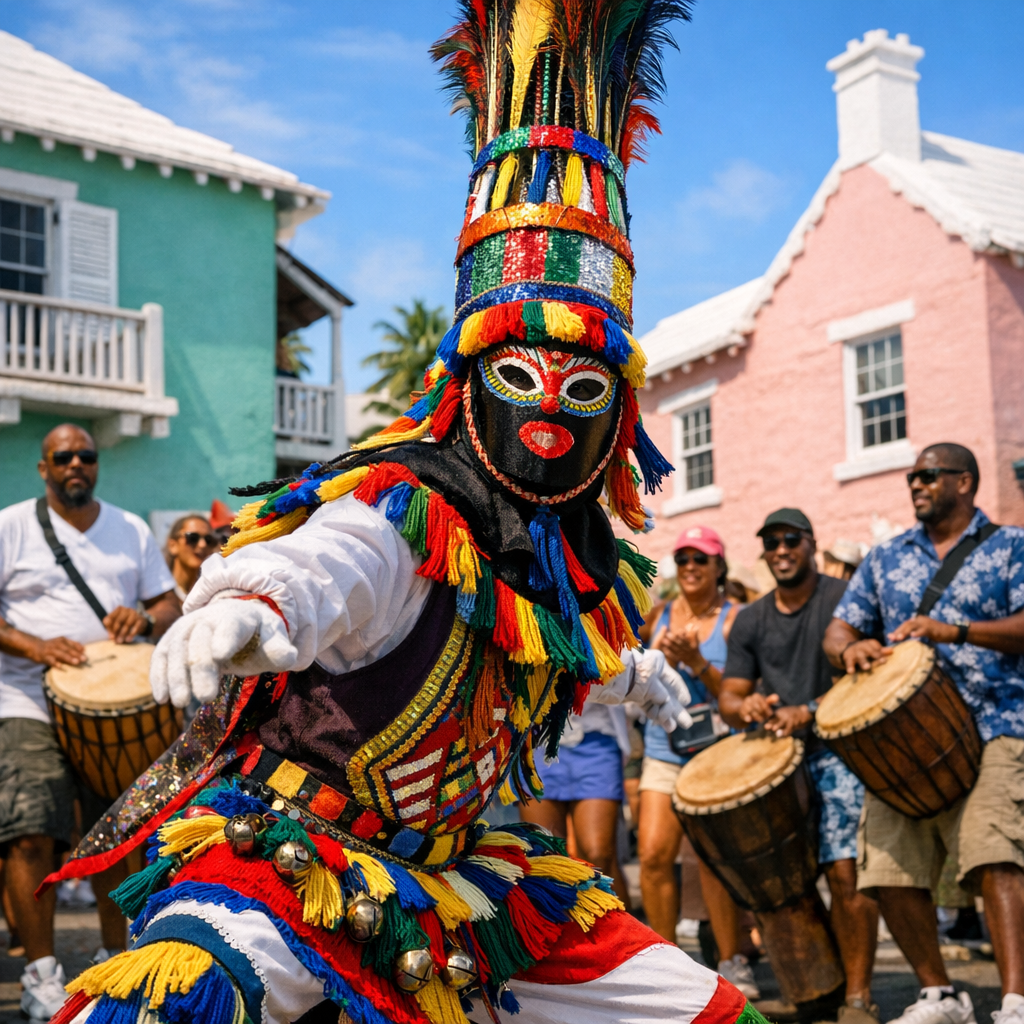
Turn a corner in Hamilton or St. George's during the right week and you'll hear it before you see it — a driving, syncopated drumbeat rising over the shuffle of feet and the jingle of bells. Then they appear: masked figures in towering feathered headdresses, capes trimmed in mirrors and tassels, moving through the street in a hypnotic, athletic performance that is part dance, part military march, part spiritual release. This is Gombey (pronounced GUM-bay), and it is Bermuda's most important cultural export — a living, breathing art form built by Black Bermudians out of the wreckage of slavery, and it deserves top billing over any beach.
Born in Bondage, Built to Last: The Roots of Gombey
Gombey is distinctly Bermudian — you won't find its exact form anywhere else — but its DNA is a fusion of traditions that collided on this small British Overseas Territory. Enslaved West and Central Africans, brought to Bermuda from as early as the 1600s, carried masking and drumming traditions rooted in West African ceremony. Indigenous influences, from Native American communities transported to Bermuda by British colonizers and broader Caribbean/North American Indigenous aesthetics, shaped the feathered headdresses and elements of the costuming and movement. And the British military bands stationed on the island for centuries contributed the snare drums, fife, and formal marching-troupe structure that give Gombey its distinctive martial precision.
What makes the history powerful is why it exists at all. Enslaved Bermudians were forbidden from practicing many of their own traditions openly, and were typically permitted to perform only once a year, around Christmas. The mask became protection — a way to critique, celebrate, and simply be seen without facing direct retaliation from enslavers. An 1831 newspaper dismissed the practice as a "ridiculous show." Nearly two centuries later, Gombey appears on Bermuda's postage stamps and is its most unmistakable cultural signature — an arc from suppressed protest to national treasure that every visitor should understand before lifting a phone to record one.
A Gombey troupe is a serious operation, not a random street performer. Groups typically run 10 to 30 dancers, led by a Captain and a Chief, moving to a "Mother Drum" (a deep bass drum anchoring the rhythm), paired snare drums playing call-and-response riffs, kettle drums, and a fife cutting through the top of the mix. Each troupe — some family lines have passed the tradition down for generations — has its own recognizable costume colors, mask style, and drumming signature that locals can identify from a block away.
When and Where to Actually See One
Gombey isn't a tourist show that runs on a schedule for visitors — it's a living tradition tied to specific dates on the Bermudian calendar, which is exactly what makes catching a performance feel like witnessing something real rather than staged. The best-known performance windows are:
- Boxing Day (December 26) — historically the single biggest Gombey day of the year, when troupes parade through Hamilton and surrounding parishes.
- Christmas Day and the broader Christmas season — smaller, informal appearances in neighborhoods across the island.
- New Year's Day — troupes perform to welcome the year.
- Bermuda Day (May 24) — the island's biggest public holiday, marked by a parade through Hamilton that regularly features multiple Gombey troupes alongside majorettes and marching bands.
If your trip doesn't line up with those dates, look for Gombey at cruise ship arrivals, cultural festivals, and hotel events year-round — many properties now book troupes specifically because visitor demand has grown. But there's a real difference between a troupe hired for a hotel courtyard and one parading through St. George's on Bermuda Day surrounded by Bermudians who grew up with this tradition in their own families. If you can plan around Boxing Day or Bermuda Day, do it.
St. George's: Walking Through a UNESCO World Heritage Old Town
Gombey performances in Bermuda's old capital carry extra weight because of where you're standing. The Historic Town of St. George and its Related Fortifications were inscribed as a UNESCO World Heritage Site in 2000, recognized as the oldest continuously inhabited English settlement in the New World, founded in 1612 — predating even the more famous Plymouth Colony. St. George's served as Bermuda's capital until 1815 and later played logistical roles during both the American Revolution and the Civil War.
Wander its narrow lanes and you'll find candy-colored colonial buildings, King's Square, the town's original stocks and pillory, St. Peter's Church — one of the oldest surviving Anglican churches in the Western Hemisphere — and Fort St. Catherine guarding the harbor entrance. It's a rare combination: a UNESCO site you can explore in an afternoon of flip-flops and iced tea, then watch a masked Gombey troupe stomp through the same square where English settlers first came ashore four centuries ago.
Important: Bermuda Is Not in the Caribbean
Here's a correction worth making clearly, because it trips up a lot of travelers: Bermuda is not part of the Caribbean. Geographically, it sits alone in the North Atlantic Ocean, roughly 650 miles east of North Carolina — closer to New York than to Jamaica. It has no connection to the Caribbean tectonic plate, the Antilles island chain, or the Caribbean Sea at all.
Bermuda gets lumped into "Caribbean" travel content constantly because of shared British colonial history, a similar climate profile, and its popularity within Black diaspora travel circles — including in our own roundup of Caribbean islands for Black travelers, where it appears as an Atlantic-basin honorable mention. But if you're picturing a quick island-hop itinerary between Bermuda and, say, Barbados or the Bahamas, recalibrate: this is a standalone trip, reached by direct flight from the US East Coast, not a stop on a multi-island Caribbean run.
The Price Point: Be Ready to Spend More
The other thing to know going in: Bermuda is expensive, even by Caribbean-adjacent luxury standards. Expect a realistic budget starting around $1,800 per person for four nights, before you get aggressive with dining and excursions. Hotel rates, restaurant checks, and taxis all run noticeably higher than comparable experiences in Jamaica, the Dominican Republic, or the Bahamas. Bermuda doesn't do budget hostels or all-inclusive mega-resorts — its hospitality model leans boutique cottage colonies, small luxury hotels, and high-end guesthouses. That's not a reason to skip it, it's a reason to plan for it: build the trip around the cultural calendar, book early, and treat it as a splurge destination rather than a bargain one.
Getting There and Getting Around
L.F. Wade International Airport (BDA) near Hamilton has direct flights from numerous US East Coast cities — New York, Boston, Washington DC, Atlanta, Philadelphia — with flight times of roughly 2 to 2.5 hours, making Bermuda one of the most accessible "far away" destinations for US travelers. Seasonal connections from Toronto and London also run.
US citizens need a valid passport to enter Bermuda; no tourist visa is required for standard short stays as a British Overseas Territory. Entry requirements can shift, so confirm current arrival procedures shortly before departure. On the ground, rental cars aren't available to visitors — Bermuda law restricts car rentals to residents. Getting around means the pink-and-blue public buses, ferries between Hamilton, St. George's, and the Royal Naval Dockyard, taxis, or renting a scooter to explore at your own pace.
Where to Stay
Boutique Luxury: The Loren at Pink Beach and Rosewood Bermuda offer the island's finest small-property experiences, with private beach access and design-forward rooms. Cambridge Beaches, a historic cottage colony, has hosted guests since the 1920s.
Mid-Range: Grotto Bay Beach Resort and Elbow Beach offer strong relative value, with easy beach access and proximity to Hamilton. Staying in or near St. George's puts you within walking distance of the UNESCO old town and the island's most historic Gombey performance routes.
🏨 Book Bermuda Hotels →Best Time to Visit
For weather alone, May through October delivers warm temperatures (75-85°F) and calm seas, with July and August the warmest and busiest. If witnessing Gombey is a priority — and it should be — plan around Bermuda Day (May 24), which sits right at the start of the good-weather season, giving you the best of both. December's Christmas and Boxing Day performances happen in a cooler, quieter shoulder season with lower hotel rates, if you don't mind trading beach time for cultural immersion.
Budget Guide
Mid-range: $350-450/day — boutique guesthouse or smaller hotel, casual dining, public transport and ferries, free cultural sites.
Luxury: $500-800+/day — five-star cottage colony or resort, fine dining, private tours, scooter rental.
Four nights at a mid-range pace lands close to the $1,800 per person benchmark once flights are included — budget upward from there for peak weeks like Bermuda Day and Cup Match.
BTN Insider Tips
Don't just photograph a Gombey troupe — tip them. Informal neighborhood performances are often supported by onlookers contributing directly; it's respectful and supports the tradition.
Book a heritage or Gombey-focused walking tour in St. George's. Local guides can point you toward troupe rehearsals and explain costume symbolism you'd otherwise miss.
Reserve dinner, not just hotels, in advance. Bermuda's best restaurants are small and book up fast around Bermuda Day and Cup Match weekend.
Pack sturdy shoes for St. George's cobblestones and a layer for cool evenings.
Must-Try Food and Drink
Bermuda fish chowder — a rich, dark, roux-based chowder finished tableside with a splash of sherry peppers and Gosling's Black Seal rum — is the dish to order everywhere and compare across restaurants. Pair it with a proper Dark 'n' Stormy, Bermuda's signature cocktail and arguably its most successful global export after Gombey itself. Also seek out a Bermuda fish sandwich (fried fish on raisin bread, a genuinely essential local ritual), cassava pie around the holidays, and spiny lobster in season (September through March).
Is Bermuda Safe for Black Travelers?
Bermuda is consistently rated as very safe, with low violent crime and a majority Black population (roughly half of residents identify as Black or of African descent) whose culture — Gombey chief among it — is centered in the island's national identity rather than a sideline. Standard precautions apply in Hamilton at night, and scooter safety on the island's narrow, winding roads deserves real attention.
Mark Your Calendar
- December 25-26 — Christmas Day and Boxing Day Gombey performances, island-wide
- January 1 — New Year's Day Gombey performances
- May 24 — Bermuda Day, Hamilton parade with multiple Gombey troupes
- Late July/early August — Cup Match, Bermuda's biggest sporting and cultural holiday weekend
Book Your Bermuda Trip
Bermuda isn't a beach add-on to a Caribbean itinerary — it's a standalone North Atlantic destination with one of the most extraordinary living cultural traditions the Black diaspora has produced anywhere in the world. Come for the pink sand. Stay for the drumbeat that's been protecting Bermudian identity for nearly 400 years.
✈️ Book Your Bermuda Trip Now →*Affiliate links — BTN may earn a commission at no extra cost to you.