Where the Road Ends at the Ocean
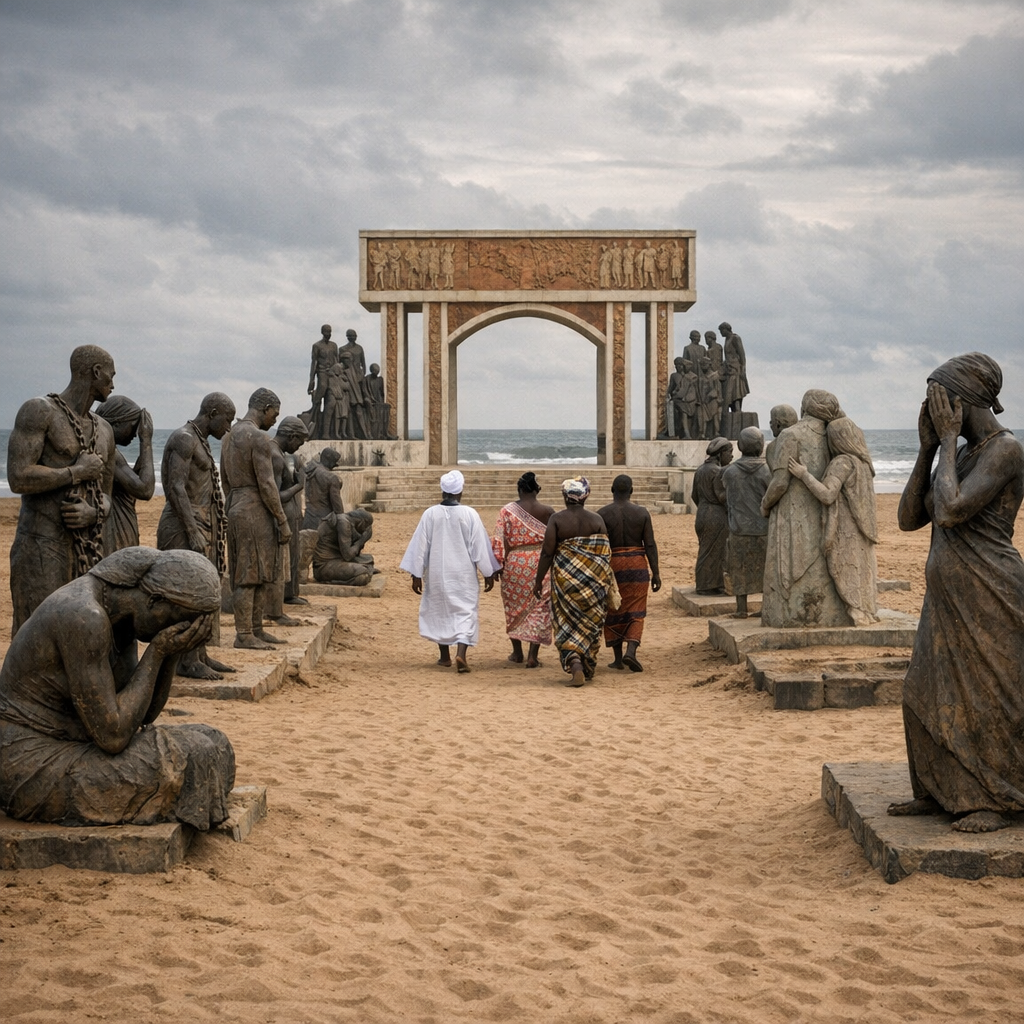
There is a four-kilometer stretch of road in southern Benin that carries more weight than almost any road on the continent. It begins in the center of a quiet town called Ouidah, winds past a market square, a sacred forest, and a colonial fort, and ends at the edge of the Atlantic, where a bronze-and-stone arch stands facing the water. This is the Route des Esclaves — the Route of the Enslaved — and the arch is the Door of No Return.
For diaspora travelers whose ancestry traces to West Africa, Ouidah is one of the few places on Earth where the machinery of the transatlantic slave trade can be walked, step by step, from the point of sale to the point of departure. In a striking act of historical symmetry, this same town is also the spiritual capital of Vodun — the West African religion that survived the Middle Passage and reshaped itself into Haitian Vodou, Brazilian Candomblé, Cuban Santería, and Louisiana Voodoo. This guide covers both halves of Ouidah's story — the memorial and the living culture — along with the practical realities of visiting a country still building its infrastructure for international travelers.
The Route des Esclaves: Walking Where History Happened
Walking the Route des Esclaves, ideally with a knowledgeable local guide, is the single most important thing a heritage traveler can do in Benin.
Place Chacha — The route begins at the old auction square, marked by a tree planted in 1747. Here, captives who had survived forced marches from the interior were bought and sold. Descendants of the diaspora now tie ribbons and flags from their home countries to its branches.
The Tree of Forgetting — Enslavers forced captive men to circle a tree nine times and women seven, a ritual meant to erase memory of name, family, and homeland before the march to the coast. The original tree no longer stands, but the site remains one of the route's hardest stops.
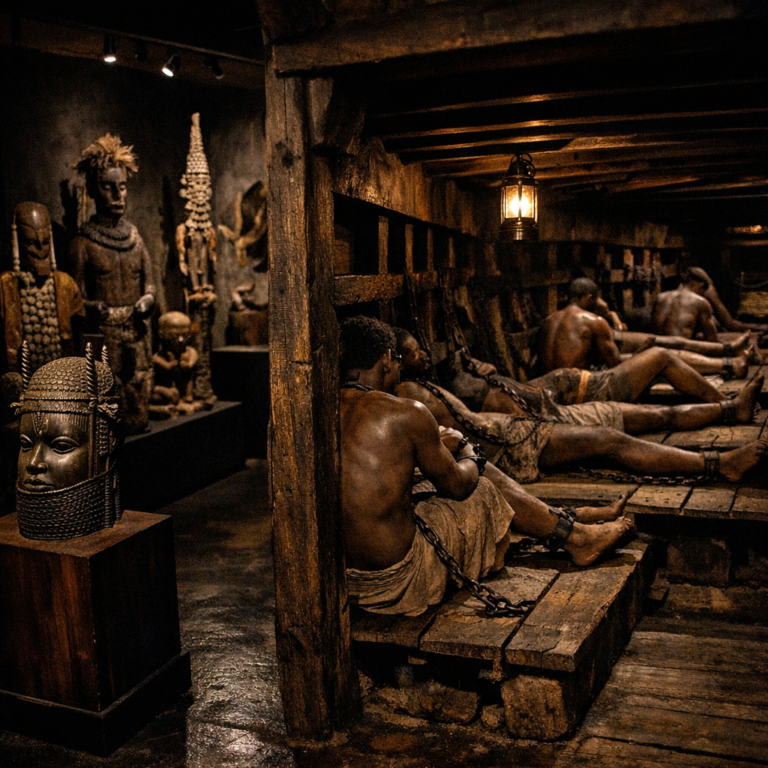
Zomaï, the House of Darkness — Here branded captives were held in cramped, lightless conditions for up to two weeks — deliberate psychological subjugation before the final march.
The Zoungbodji Memorial — A mass grave for those who died in captivity before ever reaching the ships, marked today by somber contemporary art, including a wall of remembrance.
The Tree of Return — This original tree still stands. Captives circled it three times, praying that if their bodies were taken, their spirits would find their way back to African soil after death. It is one of the route's most quietly devastating stops.
The Door of No Return — The route ends on a beach at the Gulf of Guinea, where enslaved people were rowed out to waiting ships. Historians estimate roughly one million enslaved people passed through Ouidah, most bound for Brazil and the Caribbean. The monument here — an arch flanked by relief sculptures and Egungun ancestral figures — was created by Beninese architect Yves Ahouen-Gnimon and sculptors including Fortuné Bandeira as part of "Ouidah '92," a UNESCO-backed heritage project that reclaimed the site as a place of memory. Facing the arch toward the horizon the ships once crossed is an experience that stays with you.
The Portuguese Fort and Ouidah Museum of History
Near the start of the route sits the Fort of São João Baptista de Ajudá, a Portuguese colonial fort completed in the early 18th century and handed back to Benin in 1961. It now houses the Ouidah Museum of History, tracing the port's trade with Brazil and Portugal alongside the Vodun traditions that took root here. Give it at least an hour before heading to the beach.
Ouidah: The Spiritual Capital of Vodun
Vodun is recognized as an official religion in Benin — not a Hollywood caricature, but a structured spiritual system built around a pantheon of deities, ancestor veneration, and an active relationship between the spirit world and the living. Enslaved Beninese and other West Africans carried this belief system across the Atlantic, where it transformed into Haitian Vodou, Cuban Santería, Brazilian Candomblé, and Louisiana Voodoo. Walking the Route des Esclaves and then visiting a Vodun shrine in the same afternoon traces a single unbroken cultural thread across the ocean and back.
Temple des Pythons — Near the Basilica of the Immaculate Conception, this small temple houses dozens of sacred royal pythons, revered as protective spirits and treated with genuine reverence rather than as a tourist gimmick.
Sacred Forest of Kpassè — A tranquil forest sanctuary of sculptures representing Vodun deities, dedicated to Kpassè, Ouidah's founder, who local belief holds transformed into a tree rather than die.
Vodun Days: Benin's National Festival, Every January 10
January 10 is a public holiday in Benin — National Vodun Day — and Ouidah is where the country celebrates it. Since 2024, the single day has expanded into "Vodun Days," a multi-day national festival featuring Egungun masquerade performances, Zangbeto straw-costumed guardian performers along the seafront, Mami Wata water-spirit rituals on the beach, ceremonies in the Sacred Forest of Kpassè, and a grand procession that follows the Route des Esclaves down to the Door of No Return — uniting the memorial route and the living faith in one public event, alongside concerts and art exhibitions.
As of today, the next edition falls on January 10, 2027 — under six months out, making now the time to start planning. Hotel rooms in and around Ouidah are limited, so book well ahead of the festival.
A Door Opening the Other Way: Benin's Citizenship Law for the Diaspora
In July 2024, Benin's National Assembly passed a law (promulgated that September) allowing people of African descent outside the continent to apply for Beninese nationality with documented ancestral ties to victims of the transatlantic slave trade. Applicants must be at least 18, hold no other African nationality, and can support claims with civil records, authenticated testimony, or DNA evidence. In July 2025, the government launched a digital platform, "My Afro Origins," to process applications, with a modest fee and a review window of a few months.
The law made international headlines that month when singer Ciara became one of its first recipients at a naturalization ceremony in Cotonou, then traveled to Ouidah to walk the Route des Esclaves and stand at the Door of No Return, calling it "a profound return to what truly matters." Diaspora travelers exploring their own family history should research current eligibility directly through Benin's government channels, since documentation standards are strict.
Entry Requirements: Visa and Yellow Fever Vaccination
Benin is not visa-free for US citizens. Apply in advance through Benin's official e-visa portal, uploading a passport scan, photo, proof of accommodation, and a return ticket; processing generally takes a few business days.
Critically, proof of yellow fever vaccination is mandatory for all travelers entering Benin, from any country of origin. Carry your International Certificate of Vaccination ("yellow card"), administered at least ten days before arrival — confirm this with a travel clinic before booking, as border officials do check.
If navigating the government e-visa portal yourself feels daunting, third-party e-visa processing services (iVisa is a well-known option) can handle the paperwork and document checks for a service fee — a reasonable trade-off for travelers who'd rather not risk a rejected application close to departure.
Check the current US State Department advisory before you go. As of early 2026, Benin sits at Level 2 ("Exercise Increased Caution"), with explicit "Do Not Travel" guidance for northern border areas near Burkina Faso, Niger, and parts of Nigeria due to terrorism and kidnapping risk. Ouidah and the southern coastal region, where most travelers spend their time, are a different picture — but read the advisory in full and register your trip with the embassy.
Getting There and Getting Around
Benin has no direct flights from the United States. Connect through a hub — Paris (Air France), Brussels (Brussels Airlines), Addis Ababa (Ethiopian Airlines), or Casablanca (Royal Air Maroc) are common routings — into Cadjehoun Airport (COO) in Cotonou. From there, Ouidah is a straightforward 40-kilometer, roughly hour-long drive west; arranging a driver or guided day tour from Cotonou is simplest for a first visit.
Ouidah's tourism setup is far smaller-scale than Accra's or Cape Coast's. There's no Uber; zemidjan motorcycle taxis (yellow shirts) handle short hops, and licensed site guides are inexpensive and worth hiring. French is Benin's official language, and outside hotel staff in Cotonou, English is not widely spoken — a translation app and a few French phrases go a long way. Fon and other local languages are spoken widely alongside French.
What to Eat
Beninese cuisine deserves more attention than it gets. Try amiwo, a smooth tomato-rich corn porridge often served with grilled fish or chicken; akassa, fermented corn dough served alongside stews; gboma dessi, a hearty spinach and meat stew; and fresh grilled fish with rice or attiéké. Street-side grilled chicken (poulet braisé) with spicy pilipili sauce is a reliable, delicious constant.
Where to Stay & Budget Guide
Ouidah's accommodations are modest — small guesthouses and boutique properties rather than international chains. Many travelers base in Cotonou, where options are wider, and take Ouidah as a day trip or overnight. Book early around January 10, when rooms fill fast for Vodun Days.
Budget: $40–70/day — guesthouse lodging, street food, zemidjan transport, site entry fees.
Mid-range: $80–150/day — better Cotonou hotels, a private driver, guided tours.
Luxury: $200+/day — the handful of upscale Cotonou properties, plus private guides throughout.
BTN Insider Tips
Hire a guide for the Route des Esclaves — the history and Vodun cosmology behind each site aren't always obvious from signage alone.
Dress and behave with reverence — this is sacred ground both as a memorial to immense suffering and, in places, an active Vodun worship site.
Confirm your yellow fever vaccination before booking flights — this is a hard entry requirement, not a suggestion.
Bring CFA francs (XOF) in cash — card acceptance is limited outside Cotonou's larger hotels.
Plan around January 10 if the festival draws you, and book accommodations and a guide months in advance.
Is Benin Safe for Black Travelers?
Southern coastal Benin, including Cotonou and Ouidah, is generally calm, and diaspora visitors researching ancestral heritage are received with real warmth, particularly given the country's active outreach to descendants of the enslaved. Benin overall carries a Level 2 US State Department advisory, with explicit avoidance guidance for northern border regions far from the coastal heritage circuit covered here. Register with the embassy, keep copies of your documents, and stay informed on current conditions.
Book Your Benin Trip
Ouidah asks something different of travelers than most destinations do. It asks you to sit with grief before it offers you wonder — and then it offers you both, fully and without flinching. Few places let you trace a single unbroken line from an ancestor's forced departure to a living faith that outlasted the ships, the auction blocks, and the centuries. Ouidah is one of them.
✈️ Start Planning Your Benin Trip →*Affiliate links — BTN may earn a commission at no extra cost to you. This includes hotel booking links and e-visa processing service referrals; we only recommend services we'd use ourselves.