A River Delta With a Buried History
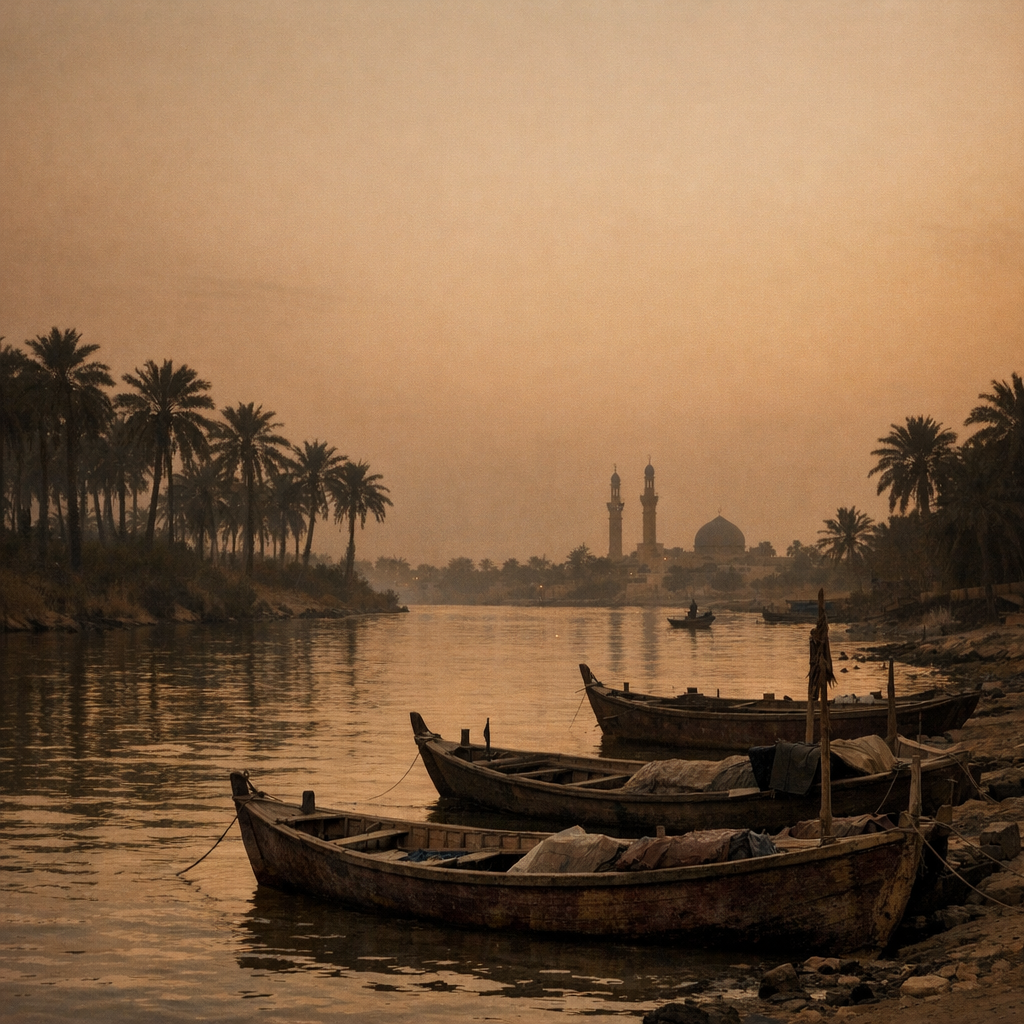
Where the Tigris and Euphrates rivers converge into the Shatt al-Arab, near the southern Iraqi city of Basra, date palm groves once stretched for miles along marshland and salt flats worked, for centuries, by enslaved people brought across the Indian Ocean from East Africa. Most people who know Basra know it as an oil city, a port city, a place that shows up in headlines about war and reconstruction. Almost nobody outside Iraq knows it as the site of one of the largest slave uprisings in recorded human history — or that the descendants of the people who staged that uprising are still there, still southern Iraqi, and still largely invisible in the country's national story.
This is the history of the Zanj Rebellion, and of the Afro-Iraqi community that carries its legacy today. It deserves to be told with the same seriousness the diaspora gives Cape Coast Castle, Gorée Island, and the Citadelle Laferrière — not because it is identical to those histories, but because it belongs in the same conversation, and it has been left out of it for far too long.
The Zanj Rebellion: An Uprising Against an Empire
Between 869 and 883 AD, the salt marshes and agricultural lands surrounding Basra became the staging ground for a fourteen-year revolt against the Abbasid Caliphate — then one of the most powerful empires on Earth. The rebels were known as the Zanj, an Arabic term used at the time for East Africans, and the uprising that bears their name is counted among the largest and longest-sustained slave revolts in world history, alongside the Haitian Revolution nearly a millennium later.
The people who rose up were enslaved and recently freed Africans, brought into southern Iraq through Indian Ocean and Persian Gulf trade routes to perform brutal agricultural labor — clearing the nitrous topsoil of the Sawad marshlands so the land beneath could be cultivated. It was punishing, degrading work, done in large forced labor gangs under conditions contemporary chroniclers themselves described as harsh even by the standards of the era. Historians today believe the rebel ranks were not exclusively East African; they were joined by other oppressed and marginalized people of the region — semi-liberated laborers, craftsmen, and clients of prestigious families who saw in the revolt a chance to challenge a deeply unequal social order. But it was the Zanj who gave the rebellion its name, its early leadership, and its lasting historical identity.
Fourteen Years Against the Caliphate
Led by a figure named Ali ibn Muhammad, the rebellion grew from a localized uprising into a force capable of contesting Abbasid authority across a wide stretch of southern Mesopotamia. At its height, the rebels controlled territory reaching to within roughly fifty miles of Baghdad itself by 879 — a staggering fact given that Baghdad was the seat of one of the wealthiest and most militarily capable empires of the medieval world. The rebellion disrupted trade, devastated regional agriculture, and forced the caliphate to divert enormous military resources away from other fronts, weakening its grip on distant provinces during the years the revolt dragged on.
Casualty figures from this era are notoriously difficult to verify, and medieval chroniclers were prone to exaggeration in both directions. Contemporary sources offered death tolls ranging into the hundreds of thousands, figures modern historians generally consider inflated; more measured modern estimates still describe tens of thousands of lives lost and entire regions left in ruin. What is not contested is the rebellion's scale and duration — fourteen years is an extraordinarily long run for any pre-modern revolt to sustain itself against a centralized imperial army. By 883, Abbasid forces under the general al-Muwaffaq, and later his son al-Mu'tadid, finally crushed the uprising. Ali ibn Muhammad was killed and his head displayed publicly — a calculated message from an empire determined to reassert that its authority, and its economic dependence on enslaved labor, would not be broken from below.
Muslim chroniclers of the period described the Zanj Rebellion as one of the most violent upheavals the caliphate had ever faced. Modern historians studying it place it among the bloodiest and most consequential revolts in the history of Western Asia — a scale of organized resistance to slavery that predates the Haitian Revolution by roughly nine centuries, even though it did not achieve Haiti's outcome of permanent, independent liberation. That the Zanj Rebellion ultimately failed to end slavery in the region does not diminish what it represents: proof, a thousand years before the Atlantic slave trade even began in earnest, that enslaved Africans organized, fought, and very nearly broke an empire that depended on their bondage.
The Afro-Iraqi Community Today
The descendants of the Zanj, and of the East African Bantu and Swahili peoples brought into Iraq through later centuries of the Arab slave trade (a trade that continued in the region long after the rebellion, into the 19th century and beyond), still live in southern Iraq today — concentrated in and around Basra, along with the neighboring provinces of Maysan and Dhi Qar, particularly the Al-Zubair district. Slavery was not formally abolished in Iraq until 1924, by royal decree under King Faisal I, meaning the institution that produced this community persisted for more than a millennium after the rebellion that first challenged it.
No official census tracks ethnicity in Iraq, so population figures vary by source and are frequently disputed. Afro-Iraqi community leaders and advocacy groups have cited estimates ranging from roughly 500,000 to as many as 1.5–2 million people, while acknowledging that no government body has verified any figure with certainty. What is well documented, including in reporting from researchers and regional outlets covering minority rights in Iraq, is that Afro-Iraqis continue to face real, present-day discrimination. The pejorative Arabic term "abeed" — meaning "slave" — remains in everyday use against Black Iraqis. Community members and advocates report systemic exclusion from mainstream employment and government positions, and describe a long history of being pushed toward the margins of Iraqi economic and political life, including into work as street musicians and performers when other opportunities were denied.
Despite that marginalization, cultural memory has survived. Some Afro-Iraqi communities maintain ritual and musical traditions with roots traceable to East Africa — including "tanbura" ceremonies and other rhythmic and spiritual practices blending Arabic and East African elements, historically used for community healing and cohesion. Few younger Afro-Iraqis today speak Swahili fluently, a sign of just how much has been lost to generations of assimilation pressure and social exclusion — but the traditions that remain are a direct, living thread back to the people who rose up near Basra eleven centuries ago.
A Growing Movement for Recognition
In recent years, Afro-Iraqi advocacy has become more organized and more visible. Community-led organizations have pushed for official recognition of Afro-Iraqis as a distinct minority group under Iraqi law, for anti-discrimination protections, and for meaningful political representation in a system where Black Iraqis currently hold few, if any, government positions relative to their numbers. This advocacy has drawn increasing attention from regional and international reporting on minority rights in Iraq, even as concrete policy change has been slow to follow. It is, in its own way, a continuation of the same demand the Zanj rebels raised eleven hundred years ago: to be treated as full participants in the society their labor helped build, rather than a permanently subordinate class within it.
Current Travel Reality
This history deserves to be known, even though Black Travel Now cannot currently recommend a trip to Basra to learn it in person. As of our most recent check in July 2026, the U.S. State Department maintains a Level 4: Do Not Travel advisory for all of Iraq — its highest advisory level, last updated March 2, 2026 — citing terrorism, the risk of kidnapping, ongoing armed conflict and attacks by militant groups, frequent civil unrest, and the U.S. government's limited ability to provide emergency assistance to U.S. citizens anywhere in the country. The advisory states plainly: do not travel to Iraq for any reason, and non-emergency U.S. government personnel have faced evacuation orders due to security conditions.
This advisory applies nationwide, with no regional exception for Basra or the south. Black Travel Now is not going to imply that any part of Iraq is currently safe for discretionary travel, and we have not found reporting that would responsibly support that framing. No itinerary, no logistics, no "how to visit" guide follows this article, and none will until the advisory picture changes materially and independent, on-the-ground reporting reflects that change. This piece exists to document a history and a living community, not to sell a trip.
Why This Story Matters
The African diaspora is bigger, older, and more geographically scattered than the routes most Black travel media ever covers. It runs through the Americas and the Caribbean, yes — but it also runs through the Gulf, through the Indian Ocean trade routes, through southern Iraq's salt marshes and river deltas, into communities that have been present in the Middle East for over a thousand years and are still fighting for basic recognition today. The Zanj Rebellion is one of the earliest large-scale organized revolts against slavery in recorded history, predating the Haitian Revolution by nine centuries, and yet it is almost never taught alongside it. Afro-Iraqis are a living, present-day diaspora community, not a historical footnote, and their fight for recognition is unfinished business, not ancient history.
Black Travel Now exists to map the entire Black world, including the parts of it that don't fit neatly into a booking widget. Basra's Afro-Iraqi community is exactly that kind of story — one we can't currently send anyone to visit, but one we refuse to let go untold. We'll keep watching the advisory, and when conditions ever allow it, this is a history we'd be honored to help the diaspora encounter in person. Until then, it deserves to be known, taught, and remembered exactly where it stands: as a serious, unresolved chapter of Black global history.