Barcelona's Quietest Diaspora Story
Say "Black Barcelona" out loud and you'll mostly get blank stares — even from people who know Paris's Château Rouge or Madrid's Lavapiés well. That's not an oversight on your part. Barcelona's West African and Afro-Spanish presence is real, but smaller, newer, and far less institutionally documented than the diaspora communities in Madrid, Paris, or London. There is no flagship diaspora neighborhood here, no long-running festival with an English Wikipedia page, no settled body of academic literature. What exists instead is a working-class immigrant gateway neighborhood, a hard-won street-vendor movement that turned into an actual clothing label, and the early stirrings of an Afro-Catalan cultural conversation still finding its name.
We'd rather write about that honestly than dress it up as something bigger than it is. This guide covers what's genuinely there — El Raval's immigrant history, its West African and Senegalese commercial life, and the emerging conversation around Afro-descendant identity in Catalonia — alongside the practical logistics of getting to Barcelona. If you've read our companion piece on Madrid's Lavapiés and its Equatoguinean ties, think of this as the quieter second chapter of the same Spain story.
El Raval: A Neighborhood Built by Newcomers
El Raval sits just off La Rambla, wedged between the Gothic Quarter and Barcelona's port, and has been the city's working-class, immigrant-receiving neighborhood for well over a century. Long before it was known for MACBA's contemporary art crowd or the produce stalls of La Boqueria at its northern edge, Raval was a dense port-adjacent quarter of dockworkers, cheap housing, and — for decades — a red-light and cabaret reputation that gave it the old nickname "Barrio Chino."
That combination of cheap rent and central location made Raval Barcelona's default entry point for successive waves of immigrants: Filipino families arriving through Spain's colonial-era ties to the Philippines, South Asian and Pakistani communities who now run much of the neighborhood's small commerce, North African and West African arrivals, and more recent growth from Eastern Europe, particularly Romania. Roughly half of Raval's residents were born outside Spain, one of the highest shares of any neighborhood in the city — which is why it feels less like a postcard version of Barcelona and more like a genuinely international, occasionally rough-edged crossroads.
A transparency note: precise, current population figures for Senegalese or West African residents specifically within Raval — as opposed to Barcelona or Spain overall — aren't consistently reported in accessible English-language sources. Nationally, Senegalese nationals numbered roughly 109,000 in Spain as of early 2025, with concentrations in Barcelona and Catalonia that are harder to isolate. We're flagging that gap rather than inventing a number; Spain's Instituto Nacional de Estadística (INE) is the most authoritative starting point if you want to go deeper.
Senegalese Commerce and the Manteros Movement
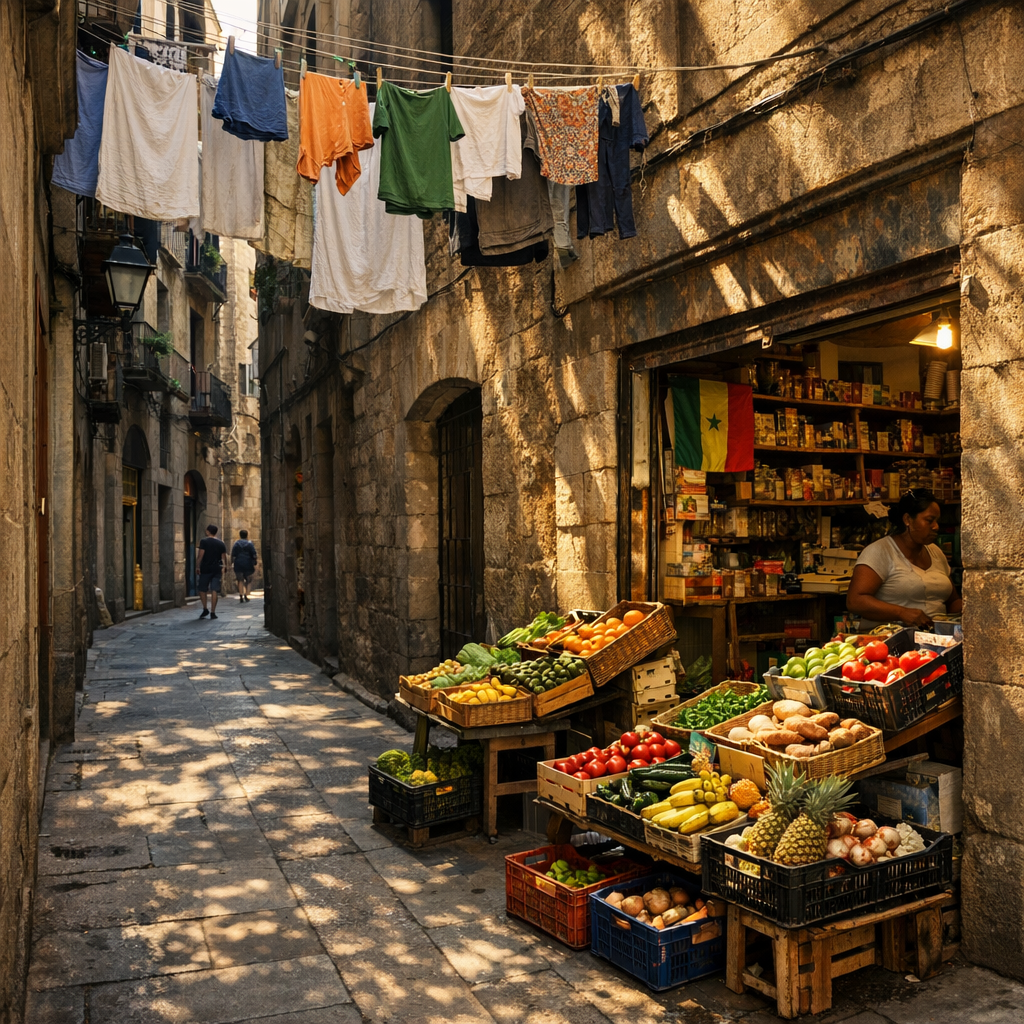
The most visible West African presence in Raval today is Senegalese: small grocery and import shops carrying West African staples, hair-braiding salons, and a handful of family-run restaurants serving Senegalese home cooking tucked into side streets around Carrer de la Riera Baixa and the blocks near Rambla del Raval. None of this amounts to a "diaspora district" in the way Lavapiés or Château Rouge function — it's closer to a real, working, mostly unmarketed commercial thread inside a much larger immigrant neighborhood.
The more internationally documented piece of this story is the manteros movement. For years, Senegalese and other West African street vendors — named for the mantas, or blankets, they spread goods on to sell quickly and pack up if police approached — have worked Barcelona's tourist corridors, an informal economy born of limited legal work options for many undocumented and asylum-seeking migrants. Barcelona's vendors organized as the Sindicato Popular de Vendedores Ambulantes (Popular Union of Street Vendors) and, in 2015, launched Top Manta, a vendor-owned clothing label that has since shown at Barcelona's alternative fashion week — a rare case of an informal migrant economy converting into a legitimate, self-run business. It's compelling, but it's rooted in precarity and real legal risk, not a curated attraction, and it deserves that context rather than treatment as a photo opportunity.
An Emerging Afro-Catalan Conversation
Beyond commerce, there's a slowly growing conversation — among scholars, activists, and Afro-descendant Catalans themselves — about what a distinct Afro-Catalan identity looks like, separate from the more established Afro-Spanish discourse centered on Madrid. This shows up in university research on migration and race in Catalonia and in the work of Catalonia-wide anti-racism organizations such as SOS Racisme Catalunya, more than in one consolidated institution.
An honest hedge: we went looking for a specific, currently active "Black Barcelona" gathering or organization to name here, and could not independently verify one at the time of publishing. If a group or event operates under that name, it lacks the visible, ongoing footprint similar efforts have in Madrid or Paris. That absence is part of the honest picture: this is a conversation in its early stages, carried by individual organizers and small collectives rather than a single, brandable fixture. Verify locally before building a trip around any specific claim you see about a fixed event.
What to Do and See
Rambla del Raval — The neighborhood's palm-lined central spine, ringed by a genuine mix of Pakistani, Filipino, Maghrebi, and West African-run shops and cafes alongside newer design-forward bars — a good place to simply sit and watch the neighborhood's actual daily life.
La Boqueria and Mercat de Sant Antoni — La Boqueria, Barcelona's famous market, sits at Raval's northern edge on La Rambla (go early to beat day-trip crowds); Sant Antoni, a less-touristed restored market just southwest, has a beloved Sunday book-and-market tradition.
MACBA and CCCB — Barcelona's contemporary art museum and its neighboring Centre de Cultura Contemporània both sit inside Raval and periodically host programming touching on migration, race, and identity in Catalonia — worth checking their calendars ahead of a visit.
Where to Eat
Senegalese and West African cooking — Small, cash-friendly spots in and around Raval serve thieboudienne (Senegal's national fish-and-rice dish), mafé (peanut stew), and yassa chicken. These are modest family operations, not restaurants built for tourists, so go with patience and an open mind.
Catalan classics — Pa amb tomàquet (bread rubbed with tomato and olive oil), botifarra amb mongetes (Catalan sausage with white beans), fideuà (a noodle take on paella, often with seafood), and crema catalana for dessert are essential alongside any diaspora exploration. Pair it with vermut hour, Barcelona's early-evening vermouth-and-tapas tradition, best at an old-school bodega rather than a designed-for-Instagram bar.
Practical Planning: Getting There and Around
Barcelona–El Prat Airport (BCN) has direct flights from New York (JFK and EWR) and other US East Coast hubs on carriers like Level, United, and Delta, typically 8-9 hours. The metro is extensive and inexpensive, with Raval served by the L3 (Liceu) and Sant Antoni stations, and the neighborhood itself is compact and entirely walkable.
Entry Requirements for US Travelers
As of this writing (mid-2026), US citizens can enter Spain visa-free for tourism or business for up to 90 days within any 180-day period under standard Schengen Area rules — this has not changed. Keep your passport valid for at least three months beyond your planned departure, and carry proof of return travel and sufficient funds even though it's rarely checked.
One thing to verify closer to your travel date: the EU's ETIAS pre-travel screening system (a low-cost online registration, not a visa) has been delayed repeatedly and is now targeted for a phased rollout starting in the final quarter of 2026, with a non-mandatory transitional period of at least six months before enforcement begins. In practical terms, most 2026 travelers to Barcelona still won't need ETIAS, but it could become mandatory sometime in 2027. Check the official ETIAS website and the US State Department's Spain page before you book, since the timeline has shifted before.
Best Time to Visit
April through June and September through October offer Barcelona's most comfortable weather — mild temperatures, manageable crowds compared to peak summer, and outdoor market and street life at its best. July and August bring intense heat, beach crowds, and the highest prices of the year; winter is mild but grayer and quieter, with many small family-run businesses in Raval keeping shorter hours.
Budget Guide
A realistic starting budget for a US traveler is around $900 for round-trip flights plus four nights of accommodation, based on shoulder-season pricing.
Budget: $80-110/day — hostel or budget guesthouse, market and casual meals, metro transport, free museum days.
Mid-range: $130-220/day — boutique hotel, sit-down restaurant meals, paid museum and gallery entries.
Luxury: $300-500+/day — upscale Eixample hotel, fine dining, private guided tours.
Where to Stay
Raval and Gothic Quarter: budget and boutique guesthouses cluster here, though Raval's edges can feel gritty after dark. Poble Sec and Sant Antoni: quieter, increasingly popular mid-range options nearby. Eixample: Barcelona's grid-planned uptown district holds most of the city's four- and five-star hotels, a short metro ride away.
🏨 Book Barcelona Hotels → ✈️ Find Barcelona Flights →BTN Insider Tips
Don't expect a "scene" — expect a neighborhood. This is not a curated diaspora tourist circuit. Approach Raval's West African commerce the way you'd approach any real, lived-in immigrant neighborhood: with respect and without a checklist.
Watch your belongings. Raval and La Rambla have a well-earned reputation for pickpocketing aimed at tourists of every background — keep bags zipped and in front of you in crowds.
Be a respectful, paying customer at informal vendors. Street vending is a livelihood and a legally precarious one; buying counterfeit goods also carries its own legal gray area.
Verify before you build a trip around a specific "Afro-Catalan" event. We could not confirm a single, currently active flagship gathering — check local listings and community social media close to your travel dates rather than relying on secondhand claims.
Is Barcelona Safe for Black Travelers?
Barcelona is generally a safe major European city with low violent crime and heavy tourist infrastructure. As in Madrid, Spain has documented instances of racial profiling affecting Black and North African residents, including in policing of the informal street vendors described above. Most Black travelers report positive day-to-day experiences, but petty theft aimed at all tourists is a genuine, frequently cited concern in Raval and along La Rambla specifically, separate from any racial dynamics.
Mark Your Calendar
- April 23 — Sant Jordi Day, Catalonia's beloved book-and-rose festival, filling city streets including Raval's edges
- Late September — La Mèrcè festival, Barcelona's largest citywide celebration, with free concerts and performances across the city
- Year-round — Check MACBA and CCCB calendars for rotating exhibitions or panels touching on migration and Afro-Catalan identity
Book Your Barcelona Trip
Barcelona won't hand you a packaged diaspora tour, and that's the point of this guide. What it offers instead is an honest, still-unfolding thread — a historic immigrant gateway neighborhood, a hard-won vendors' movement turned clothing label, and the early edges of an Afro-Catalan conversation worth watching, not marketing. Go with curiosity and realistic expectations, and let Raval be one honest layer of a bigger Barcelona trip.
✈️ Book Your Barcelona Trip Now →*Affiliate links — BTN may earn a commission at no extra cost to you.