Bangkok Doesn't Make You Prove Yourself. It Just Welcomes You In.
Ask any Black traveler who has spent real time in Southeast Asia where to start, and the answer comes back almost every time: Bangkok. Not because it's the flashiest city on the continent — Bangkok can be chaotic, humid, and loud in ways that take a day or two to adjust to — but because it is, hands down, the easiest big Asian city for a first-timer to land in, get oriented, and immediately feel like there's a place for you here.
That "place for you" part isn't an accident or a marketing line. Bangkok has one of the longest-running, most visible Black expat communities anywhere in Asia. English teachers, entrepreneurs, remote workers, and retirees have been building lives here for decades, and the infrastructure of that community — Facebook groups, meetups, churches, barbershops, restaurants that get your seasoning right — means a visitor lands in a city that already has Black social life humming in the background. You're not the first one here, and that changes the entire texture of the trip.
Why Black Travelers Choose Bangkok
Start with the math. Bangkok is consistently one of the best-value major cities in Asia — a five-star hotel room that would run $400-500 in Dubai, Tokyo, or Seoul routinely goes for $120-180 here, and a full, excellent street meal costs $1.50-3. That value isn't a "off the beaten path" discount either; it applies at every level of the city, from backpacker guesthouses to genuinely luxurious riverside resorts.
Then there's the community. Bangkok's Black expat population is deeply tied to the ESL (English teaching) industry — international schools and language academies across the city and country have drawn Black American, British, and Caribbean teachers for years, and many stayed long after their first contract ended to build businesses, families, and creative careers. Layer on top of that a fast-growing digital nomad scene, drawn by cheap coworking spaces, fast internet, and Thailand's Destination Thailand Visa (DTV), a long-stay visa aimed at remote workers and freelancers that has become a popular option for Black creatives and entrepreneurs relocating to the city. The result is a visible, welcoming, well-organized community that a first-time visitor can plug into within days.
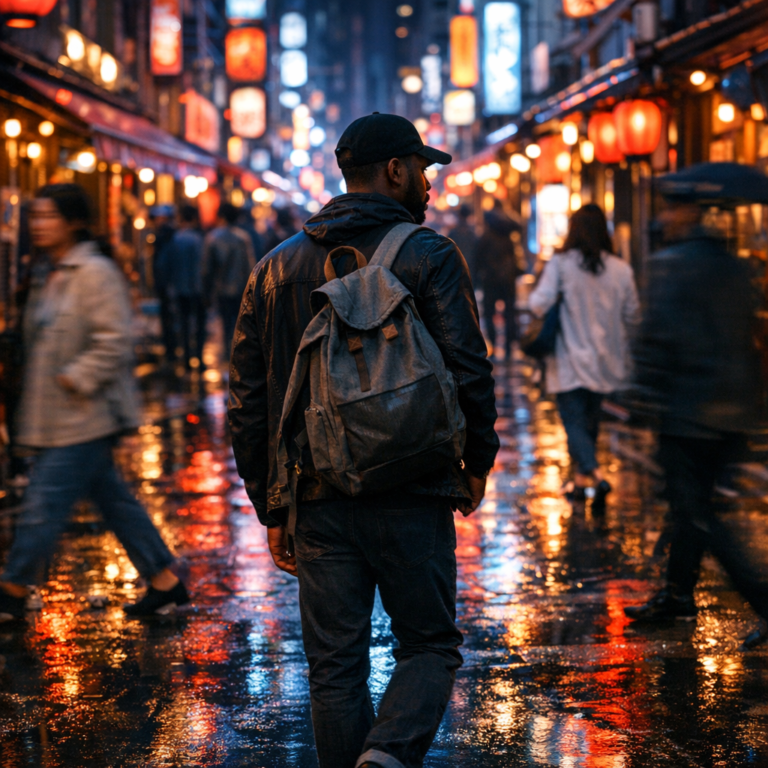
And then there's the food, the energy, the sheer sensory overload of the place in the best way — night markets that stretch for blocks, temples that glow gold at sunset, a nightlife scene that goes from rooftop bars to all-night street parties without missing a beat.
What Changed in 2026 — Read This Before You Book
Here's the part that matters most for anyone planning a trip right now. For years, Thailand's visa exemption for US passport holders allowed a generous 60-day stay with no visa application required — one of the longest visa-free windows offered by any country in the world, and a major reason Bangkok became a launchpad for longer Southeast Asia trips.
That changed in 2026. Thailand's cabinet approved a reduction of the visa-free stay from 60 days down to a tiered system, with most of the roughly 90+ affected nationalities — including the United States — moved to a 30-day visa-free stay, some nationalities capped at just 15 days, and a small number moved to visa-on-arrival requirements instead (CNN, May 2026). Thai officials cited a rise in people using the long visa-free window to run informal businesses or overstay obligations, and the shorter window is meant to tighten oversight while Thailand still aggressively courts tourism (which accounts for more than 10% of its GDP).
As of this writing, the change had been approved by Thailand's cabinet but had not yet been published in the Royal Thai Government Gazette — under Thai law, new immigration rules take effect only after gazette publication, followed by a 15-day grace period. In other words: the 60-day exemption may still be honored at the border for a window after the cabinet decision, but travelers should plan around the 30-day figure as the new normal and verify the live status before booking anything that depends on a longer stay. Check the Thai Embassy's current guidance or the U.S. Embassy Bangkok site directly before you fly — this is exactly the kind of rule that can shift again.
The second piece of the puzzle: Thailand now requires every foreign visitor to complete a Thailand Digital Arrival Card (TDAC) before entry, regardless of how long you're staying. The TDAC replaced the old paper TM6 arrival card in 2025 and must be submitted online within three days of your arrival date — it asks for passport details, your itinerary, accommodation address, and basic health declarations. It is free, takes about ten minutes, and is required in addition to (not instead of) your visa-exempt entry stamp. Do not skip it — immigration officers have turned travelers back at the counter for arriving without it. Complete it a day or two before you fly, save the QR code confirmation to your phone, and keep a screenshot as backup in case of spotty airport wifi.
Bottom line: Americans should currently plan around a 30-day visa-free stay, budget time to complete the TDAC before departure, and double-check both requirements against the current U.S. Embassy Bangkok guidance in the weeks before travel, since Thai entry policy has been unusually fluid this year.
Bangkok's Black Expat & Digital Nomad Community
The neighborhoods of Sukhumvit, Thonglor, and Ari have become informal home bases for Bangkok's international remote-work and expat crowd, with a visible and active Black presence woven throughout. Facebook groups and meetups connect new arrivals with established residents within days, coworking spaces in Ari and Thonglor double as informal social hubs, and there's a running network of Black-owned or Black-frequented restaurants, barbershops, and bars that make homesickness a lot easier to manage. Travel Noire and Essence have both profiled Black Americans who relocated to Bangkok specifically citing the cost of living, the ease of building community, and the "Land of Smiles" reputation for hospitality as reasons they stayed long past their original plans.
For a first-time visitor, this means you don't have to build a social life from scratch — search "Black expats Bangkok" or "Bangkok digital nomads" on Facebook and Meetup before you land, and you'll likely find a happy hour, a game night, or a Sunday brunch within your first week.
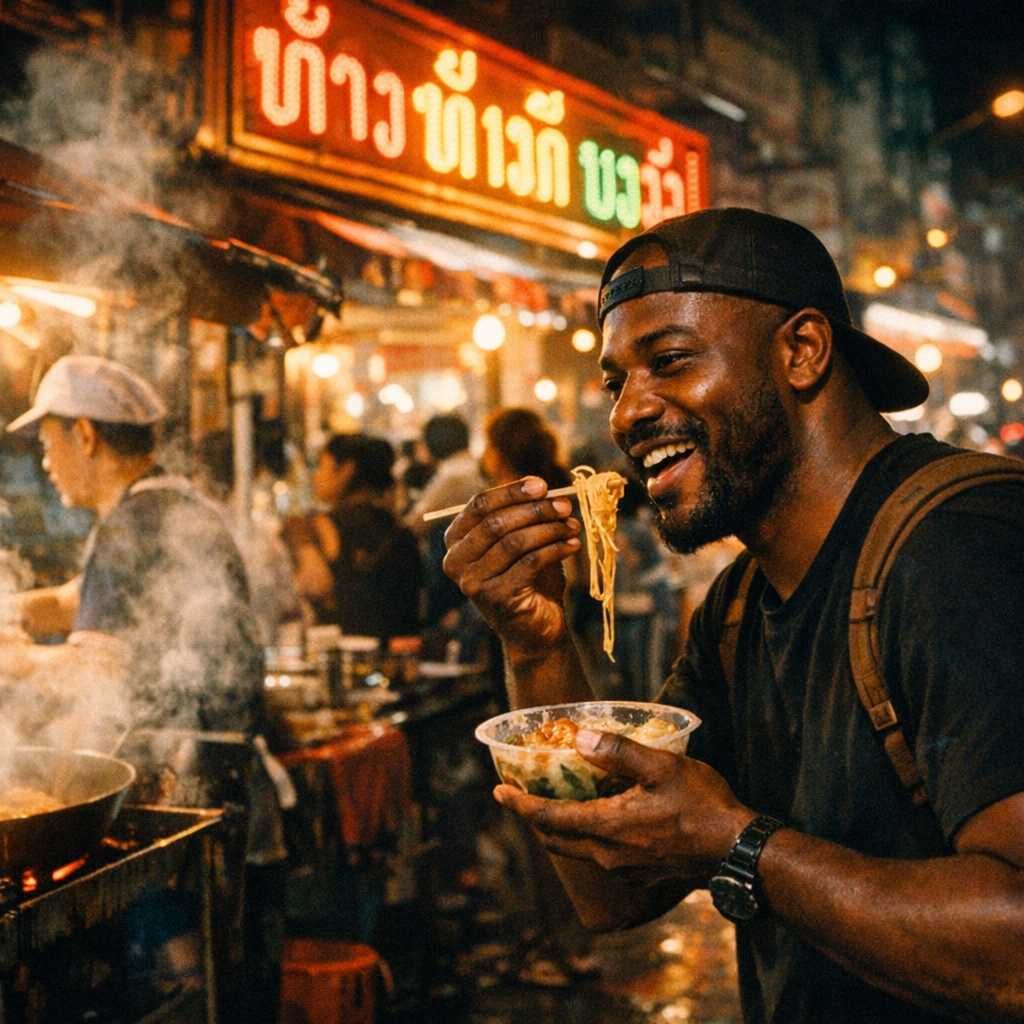
Where to Eat — Bangkok's Street Food Is the Main Event
Pad kra pao — Stir-fried holy basil with your choice of protein over rice, topped with a fried egg. Thailand's true everyday comfort food, sold from carts on nearly every block for $1.50-2.50.
Boat noodles — Rich, dark, intensely flavored noodle soup originally sold from boats along Bangkok's canals. Order small bowls (they're meant to be tiny) and work your way through several.
Khao soi — A Northern Thai coconut curry noodle soup, crispy noodles on top, soft noodles underneath. Not native to Bangkok but widely available and worth seeking out.
Mango sticky rice — Sweet, coconut-soaked sticky rice with fresh mango. The single most photographed dessert in Thailand for good reason.
Chinatown (Yaowarat) — Bangkok's most legendary night market strip, a chaotic multi-block stretch of food carts, neon signage, and roasted meats that stays busy well past midnight.
Where to Stay
Luxury: Riverside five-star properties along the Chao Phraya River deliver infinity pools, spa access, and skyline views for a fraction of comparable Dubai or Tokyo pricing.
Mid-Range: Boutique hotels in Thonglor and Sukhumvit soi neighborhoods offer stylish rooms, rooftop pools, and walkable access to nightlife and coworking spaces.
Budget: Well-reviewed guesthouses and hostels near Silom and Ari run $15-35/night with strong reviews from solo travelers and digital nomads alike.
🏨 Book Bangkok Hotels →Getting There
Bangkok's two airports — Suvarnabhumi (BKK) for most international long-haul flights and Don Mueang (DMK) for regional budget carriers — offer some of the best-value long-haul fares out of Asia, with frequent seat sales from US hubs and strong connectivity from the Middle East, Europe, and across Asia. Bangkok's status as a major transit hub also makes it a natural first or last stop on a longer Southeast Asia itinerary through Vietnam, Cambodia, or Laos.
✈️ Find Bangkok Flights →Best Time to Visit
November through February is Bangkok's cool, dry season and by far the most comfortable window — daytime temperatures sit in the mid-80s°F with lower humidity. March through May is hot season, with temperatures regularly exceeding 95°F. June through October is the rainy season, bringing daily downpours but also lower prices and thinner crowds.
Budget Guide
Budget: $40-70/day — guesthouse, street food meals ($1.50-3 each), public transit, temple entry fees.
Mid-range: $80-150/day — boutique hotel, restaurant dining, Grab rides, day trips.
Luxury: $200-400+/day — five-star riverside property, private tours, fine dining, spa treatments.
BTN Insider Tips
Complete your TDAC before you fly. It's mandatory for every visitor regardless of stay length — do it online within three days of arrival and save the QR confirmation.
Verify your visa-free stay length before booking. Plan around 30 days as the current standard for US citizens and double-check the U.S. Embassy Bangkok site or Thai Embassy guidance close to your travel date, since the rule has been in flux through 2026.
Get a local SIM at the airport. AIS, dtac, and True Move all sell inexpensive tourist SIMs with generous data — essential for Grab, maps, and staying connected with the expat community.
Use Grab over street-hailed taxis. It's metered, transparent, and avoids the "meter's broken" routine some tourist-area taxi drivers try.
Dress modestly at temples. Shoulders and knees covered are required at the Grand Palace and most major temples; scarves are sold at the entrance if you forget.
Connect with the expat community before you land. Search Facebook and Meetup for Bangkok expat and digital nomad groups — many are especially welcoming to Black travelers and can point you toward events happening during your visit.
Is Bangkok Safe for Black Travelers?
Bangkok is one of the safer major cities in Asia for tourists, with low rates of violent crime against visitors and a well-developed tourist infrastructure. Black travelers and long-term residents consistently describe Thailand as welcoming, with the country's "Land of Smiles" hospitality culture extending genuinely to international visitors. As with any major city, use standard precautions at night, stick to registered taxis or Grab, and keep an eye on belongings in crowded markets.
Mark Your Calendar
- April 13–15 — Songkran (Thai New Year) — the country's massive nationwide water festival, centered on Bangkok's streets
- November — Loy Krathong — the floating lantern festival held on rivers and canals citywide
- Year-round — Weekend markets including Chatuchak, one of the largest markets in the world
Book Your Bangkok Trip
Bangkok rewards first-timers and returning travelers alike — an easy, affordable, welcoming entry point into Southeast Asia with a Black community already in place to help you find your footing.
✈️ Book Your Bangkok Trip Now →*Affiliate links — BTN may earn a commission at no extra cost to you.