A Community Halifax Tried to Erase — and Couldn't
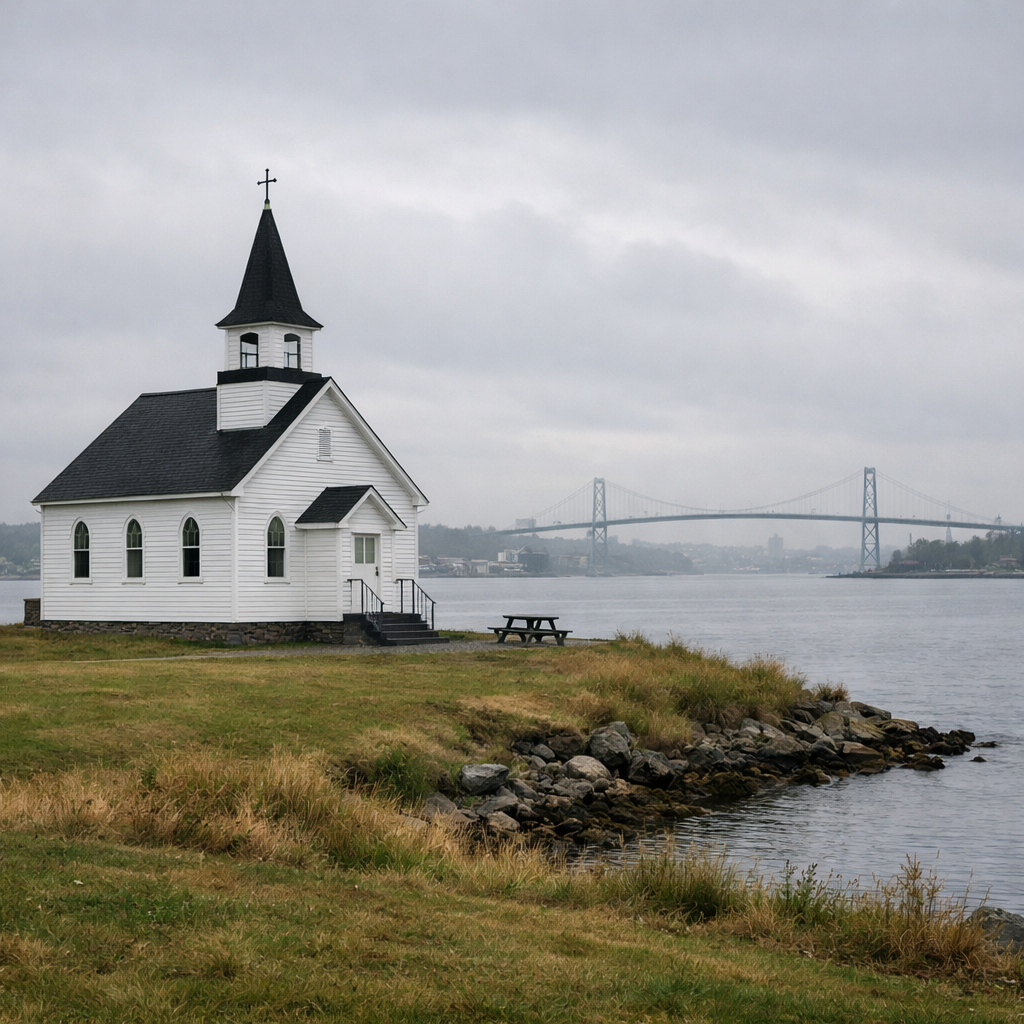
On a grassy point where Halifax Harbour meets Bedford Basin, a small white clapboard church stands alone against the water. There is no town around it — just the church, a park, a fence line, and the underside of the A. Murray MacKay Bridge rising overhead. If you didn't know the history, you might drive past it entirely.
But this was once Africville — a self-sufficient Black community that stood on this exact shoreline for more than a century, until the City of Halifax bulldozed it, house by house, in the name of "urban renewal." Today the church you see is not the original. It's a replica, rebuilt in 2011 as a museum, on the site where the real one was torn down in the middle of the night in 1967. Africville is one of the most important — and most painful — stories in Black Canadian history, and understanding it is essential to understanding Halifax itself.
Africville's Founding and a Century of Self-Sufficiency
Africville traces its roots to the mid-1700s, with the earliest official land records dating to 1761 — though Black settlement of the area likely predates that. The community grew substantially in 1848, when William Brown Sr., a formerly enslaved man who had arrived in Nova Scotia as one of the Black Refugees of the War of 1812, purchased land overlooking Bedford Basin. Combined with an adjoining parcel owned by William Arnold, the roughly 12 acres became the foundation of Africville.
By the early 20th century, Africville was home to several hundred residents — peaking around 400 by 1917. It was, by every account, a real community: families who had lived on the same land for generations, children who swam in the coves and played ball on open ground, and a deep well of mutual support that Halifax's segregated, often hostile white society did not offer. At its center stood the Seaview African United Baptist Church, established in 1849 — the true heart of Africville, and the site of baptisms, weddings, funerals, and virtually every community gathering for well over a century.
Residents worked as fishermen, farmers, domestic workers, seamen, and Pullman porters. Many owned small businesses. It was a working-class community, and by no means an easy life — but it was theirs, built and sustained by Black Nova Scotians on land their own families had held for generations.
Neglect by Design
It is essential to say plainly: Africville was not a "slum" that needed clearing, as Halifax officials characterized it at the time. It was a community the City of Halifax deliberately starved of basic services while continuing to collect property taxes from its residents — no running water, no sewer connections, no paved roads, no streetlights, despite sitting inside city limits. Worse, the city placed the infrastructure no other Halifax neighborhood would accept directly at Africville's edge: an infectious disease hospital, Rockhead Prison, a slaughterhouse, a fertilizer plant, and eventually an open-pit municipal dump just a few hundred meters from residents' homes. This was not neglect by accident. It was a pattern of decisions, made over decades, that treated a Black community's health, dignity, and property rights as expendable.
"Urban Renewal": The Demolition of Africville
In the 1960s, under the banner of urban renewal and citing the need for industrial and infrastructure development — including approaches to the new A. Murray MacKay Bridge and expanded port facilities — the City of Halifax moved to relocate every resident of Africville and demolish the community entirely.
The human cost cannot be softened. Between 1964 and 1967, families were forced from homes many had lived in for generations. Compensation was minimal, and often nonexistent: only 14 families in Africville held clear legal title to their land, a direct consequence of the city's own decades-long failure to formalize property records — which the city then used as justification to deny or reduce settlements. Some residents' belongings were loaded onto city dump trucks and hauled away alongside the debris of their demolished homes, a detail survivors and their descendants still describe as a final, deliberate indignity layered onto an already devastating loss.
The Seaview African United Baptist Church was demolished in the middle of the night on November 20, 1967 — bulldozed with so little notice that vital community records inside were destroyed along with the building. The last home in Africville fell on January 2, 1970. Its former residents were scattered across public housing projects throughout Halifax, disconnected from the land, from each other, and from the church and cemetery that had anchored their family histories.
This was not an isolated act. Africville's destruction sits within a broader pattern across North America in the mid-20th century, in which "urban renewal" programs disproportionately targeted Black neighborhoods for demolition and the seizure of land for highways, bridges, and industrial use. Africville is one of Canada's starkest examples, and it left lasting harm — economic, cultural, and psychological — that former residents and their descendants have carried for generations.
The Long Fight for Acknowledgment
Former Africville residents and their descendants never stopped organizing for recognition and redress. The Africville Genealogy Society, founded by former residents in the 1980s, became the driving force behind decades of advocacy — documenting the community's history, pressing the City of Halifax for accountability, and keeping Africville's memory alive through annual reunions on the site, a tradition that continues every summer today. That sustained advocacy is the reason Africville's story did not disappear along with its buildings, and the direct reason the city was eventually compelled to respond.
February 2010: Halifax Apologizes
On February 24, 2010, Halifax Regional Municipality's council formally and publicly apologized for the destruction of Africville. Then-mayor Peter Kelly delivered the apology on land at the former townsite, acknowledging the community's historical significance and the harm caused by its demolition. The apology came with a settlement package worth approximately $4.5 million, including the return of roughly 2.5 acres of land at the original site, funding to rebuild a replica of the Seaview church, and $250,000 in seed funding to establish the Africville Heritage Trust, the organization created to preserve Africville's history and operate a museum on the site in perpetuity.
Hold both truths here: the apology and settlement were a meaningful, hard-won acknowledgment of wrongdoing after decades of advocacy — and no amount of money or ceremony fully repairs the loss of a century-old community, its land, its cemetery access, and the generational stability taken from Black Nova Scotian families. Many former residents and descendants have said the settlement, while significant, was not sufficient given what was lost. Reconciliation here is ongoing, not finished.
The Africville Museum Today
The replica of the Seaview African United Baptist Church opened on the original site on September 25, 2011, and now operates as the Africville Museum, run by the Africville Heritage Trust. Built to the same footprint and appearance as the original 1849 church, it stands as both a place of memory and a working interpretive center.
Inside, exhibits trace Africville's founding, its century of community life, the systemic neglect that preceded its demolition, the relocation itself, and the long path to the 2010 apology — told largely through oral histories, photographs, and artifacts gathered from former residents and their families. In October 2024, the site received UNESCO designation as a Place of History and Memory linked to Enslavement and the Slave Trade, formally recognizing Africville's place within the broader global history of the African diaspora.
The surrounding land is now Africville Park (also known as Seaview Park), a public green space along the harbour where the Africville Reunion is still held every summer, drawing former residents, descendants, and visitors from across Canada and beyond.
Visiting Africville — Practical Information
The Africville Museum sits at the end of Africville Road in Halifax's North End, on the original townsite beneath the A. Murray MacKay Bridge. Regular admission (subject to change, so confirm before you go):
- Summer hours (post-Victoria Day through Labour Day): Tuesday–Saturday, 10:00am–4:00pm
- Regular hours (after Labour Day): Monday–Friday, 10:00am–4:00pm
- Admission: Adults $10; students and seniors (55+) $9; children 5 and under free (prices include 14% HST)
Plan for 45 minutes to an hour inside the museum, plus additional time to walk the park grounds along the harbour. Dogs are not permitted on the museum grounds, though the adjacent park is an on-leash dog area.
Getting There and Getting Around
Halifax Stanfield International Airport (YHZ) is the gateway to Nova Scotia, with direct flights from Toronto, Montreal, Ottawa, and seasonal service from several US East Coast cities, about 35 minutes from downtown. Africville itself is roughly a 10-minute drive from downtown Halifax in the city's North End. A rental car or rideshare is the most practical way to get there, since public transit access is limited.
Where to Stay in Halifax
Halifax's downtown and waterfront areas offer the widest range of hotels within easy reach of Africville, the harbourfront boardwalk, and the city's historic core. Boutique properties near the waterfront and larger full-service hotels downtown both put you within a short drive of the museum.
🏨 Book Halifax Hotels →Best Time to Visit
Late May through September offers the mildest weather and aligns with the museum's extended Tuesday–Saturday summer hours, plus the annual Africville Reunion held each summer on the grounds. Halifax summers are pleasant and rarely oppressively hot, typically in the high 60s to low 80s°F. Fall brings fewer crowds and dramatic coastal color, though museum hours shift to the shorter weekday schedule after Labour Day.
✈️ Find Halifax Flights →BTN Insider Tips — Visiting Respectfully
This is a site of memory, not a curiosity stop. Africville is hallowed ground — the former site of homes, a church, and a cemetery families were forcibly separated from. Approach it with the gravity of a memorial, because that is what it is.
Talk to the guides. Museum staff and volunteers frequently include descendants of former residents, and the oral history shared on-site is often more powerful than the exhibits alone.
Pair it with the wider story of Black Nova Scotia. Africville is one chapter in a much longer history of Black communities in the province, including nearby North Preston and East Preston, among the largest historically Black communities in Canada.
Must-Try Foods in Halifax
- Digby scallops — pulled from the Bay of Fundy and served throughout Halifax's seafood restaurants.
- Lobster rolls — a Maritime staple, from waterfront shacks to fine dining rooms.
- Donair — Halifax's beloved late-night invention, spiced meat and sweet garlic sauce in flatbread.
- Solomon Gundy — pickled herring, a Maritime and African Nova Scotian community-table tradition.
- Community fish fries — a longstanding tradition in Nova Scotia's historic Black communities, including North Preston, East Preston, and the former Africville itself.
Why Africville Matters to the Diaspora
Africville belongs alongside the broader story of Black communities across North America who built stable, self-sufficient lives on land later taken from them under the language of "progress" and "renewal." Visiting means standing on ground where a real community once thrived, seeing honestly what was done to it, and witnessing what descendants fought decades to have acknowledged. It is a hard visit. It is also an essential one.
Plan Your Halifax Trip
Africville asks something different of visitors than a typical destination stop — attention, humility, and a willingness to sit with a difficult history. It rewards all three.
✈️ Book Your Halifax Trip Now →*Affiliate links — BTN may earn a commission at no extra cost to you.