Ghana Doesn't Just Call You Back. It Pulls You.
There is a scene that plays out at Kotoka International Airport in Accra that no one warns you about. You clear customs, walk through the arrivals hall, and step outside into the warm West African night — and something happens that is difficult to describe and impossible to forget. The air is different here. The faces around you look like yours. The energy is unmistakably, powerfully African. And somewhere in your chest, something that has been quietly tense for your entire life begins to release.
This is Ghana. This is the homecoming the diaspora has been searching for.
Accra has become the most significant destination in the African diaspora travel movement. Since Ghana's government launched the Year of Return in 2019 — marking 400 years since the first enslaved Africans arrived in America — the country has positioned itself as the ancestral home for diaspora travelers worldwide. Hundreds of thousands have answered the call. And once you arrive, you understand why.
Why Black Travelers Choose Accra
Accra is where the diaspora comes to remember who it is. The city buzzes with Afrobeats energy — you'll hear it from car stereos, from open restaurant doors, from street speakers at 2AM. The food is extraordinary, the nightlife is world-class, the people are warm and fiercely proud of their country. And beneath all of it runs a current of ancestral connection that no other city in the world can replicate for travelers of African descent.
Beyond the emotional pull, Accra makes practical sense. The city has an excellent and growing infrastructure for international visitors — good hotels at every price point, a thriving restaurant scene, reliable Uber service, and English as the official language making navigation remarkably easy.
Must-See Monuments & Historic Sites
Cape Coast Castle — Two hours west of Accra and the most important site the African diaspora can visit anywhere in the world. This is where millions of enslaved Africans passed through the Door of No Return — loaded onto ships bound for the Americas, the Caribbean, and Europe. Walking through the slave dungeons and standing at the Door of No Return is one of the most profound and shattering experiences a human being can have. Go with a guide. Allow more time than you think you need. Let yourself feel it fully.
Elmina Castle — Ghana's oldest European building, built by the Portuguese in 1482, and the largest slave trading post in sub-Saharan Africa. Near Cape Coast, often visited in the same day. The combination of these two sites constitutes one of the most important historical pilgrimages in the world.
W.E.B. Du Bois Center, Accra — The home and final resting place of W.E.B. Du Bois, the father of Pan-Africanism, who lived out his final years in Ghana at the invitation of President Kwame Nkrumah. The center houses Du Bois's personal library and artifacts and is a deeply moving destination for anyone who understands what he meant to Black intellectual and political life globally.
Kwame Nkrumah Mausoleum & Memorial Park — Ghana's founding president and Pan-Africanist visionary is honored in this striking memorial in the heart of Accra. The museum traces Nkrumah's life and the story of Ghanaian independence in rich detail. His words on the walls here still feel urgent and alive.
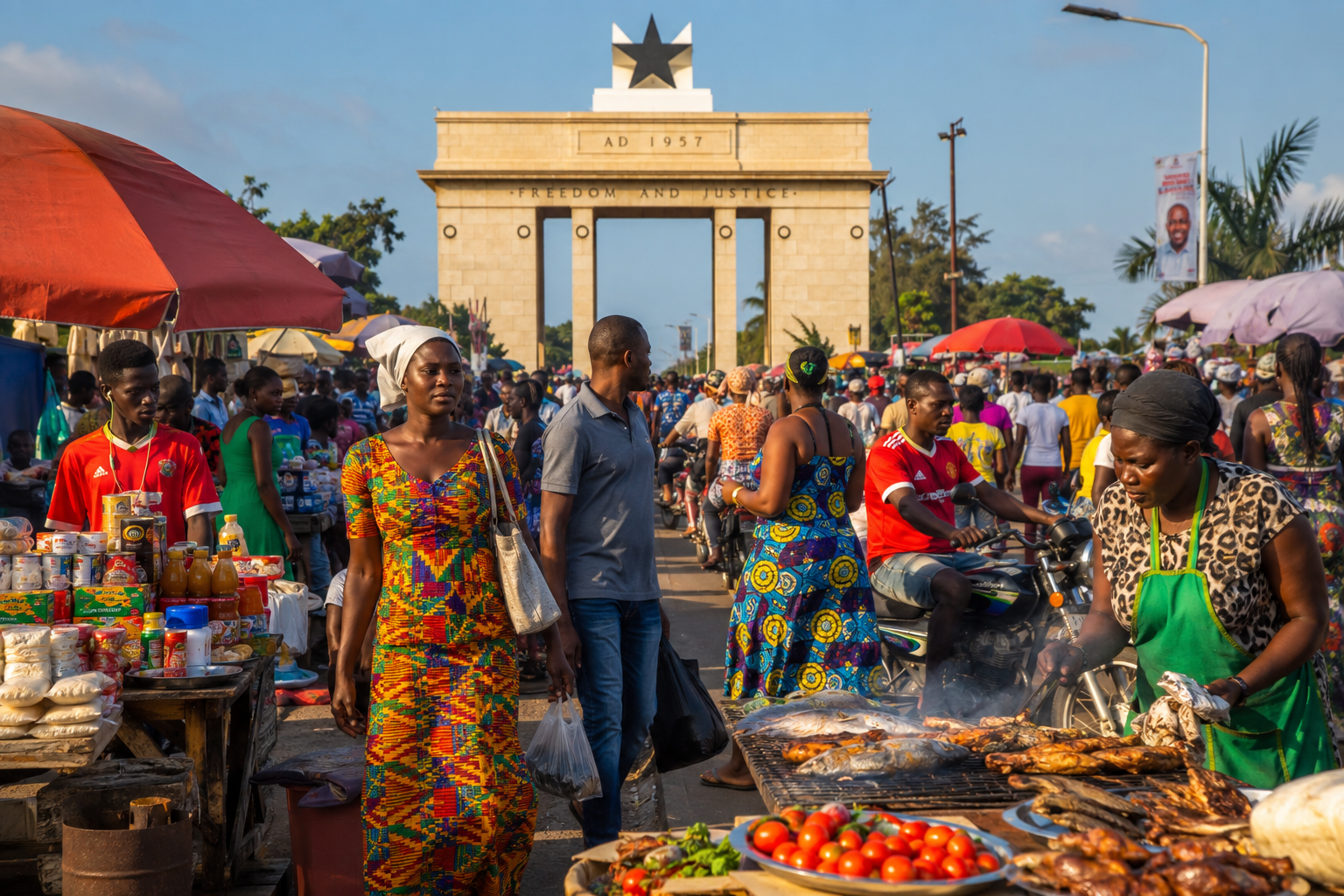
Independence Arch — Completed in 1961 and inscribed with "Freedom and Justice," Ghana's independence arch in Black Star Square is one of the continent's most recognizable landmarks. The symbolism for diaspora visitors — of a free Africa, of a country that chose its own destiny — is immense.
Top Tourist Attractions
Labadi Beach — Accra's most popular beach and the social heartbeat of the city on weekends. The energy here — music, food, dancing, families, young Ghanaians in their full Sunday best — is unlike any beach experience you'll have anywhere else. Go on a Sunday.
Makola Market — The largest open-air market in Accra and one of the most vibrant in West Africa. Fabrics, spices, electronics, fresh produce, traditional medicines — everything exists here in organized-seeming chaos. Bring cash, bring patience, and bring your sense of adventure.
Kokrobite Beach — 35km west of Accra, this relaxed beach village is the backpacker and bohemian heart of Ghana's coast. Big Milly's Backyard is the legendary gathering spot — a beach bar and guesthouse that has hosted diaspora travelers, musicians, and adventurers for decades.
Accra Arts Centre — The premier destination for Ghanaian crafts, Kente cloth, Adinkra print fabrics, carved figurines, jewelry, and artwork. Negotiation is expected and part of the experience. Budget time to browse properly.
Where to Eat — Must Try
Jollof rice — Ghana's jollof is different from Nigerian jollof (we're not getting into that debate here) and it is magnificent. Smoky, rich, served with fried chicken or fish — find it at any local chop bar for less than $3 and understand immediately why this dish is worth fighting over.
Kelewele — Spiced fried plantain sold by street vendors across Accra at night. The best kelewele in Accra is sold outside the University of Ghana campus in the evenings. Order it with groundnuts. Your life will change.
Nkate Soup (Groundnut Soup) — Ghana's most complex and beautiful stew — a rich peanut-based broth with chicken, fish, or goat. Served over fufu or rice. Order it at any traditional Ghanaian restaurant and eat with your hands if you're feeling brave.
The Republic Bar & Grill — Accra's most beloved outdoor dining institution. Cold Club beer, grilled tilapia, jollof rice, and the best people-watching in the city under open sky. Weekend nights here are unforgettable.
Buka Restaurant — Upscale West African cuisine in a beautiful setting in Labone. The suya skewers, egusi soup, and puff-puff desserts bring authentic West African home cooking to a fine dining context without losing a single ounce of soul.
Accra's Black Expat & Diaspora Community
One of Accra's greatest gifts to diaspora visitors is its thriving community of returnees — African Americans, British-Caribbeans, and diaspora members from across the world who have moved to Ghana permanently. In the neighborhoods of East Legon, Airport Residential Area, and Labone, you'll find Black entrepreneurs, creatives, and professionals who left the US and UK to build new lives here.
The diaspora community in Accra is remarkably welcoming to visitors — there are regular events, networking gatherings, and social groups specifically oriented toward connecting travelers with the returnee community. Search for events on social media before you travel and you'll likely find something happening every weekend.
Where to Stay
Luxury: Kempinski Hotel Gold Coast City is Accra's finest five-star property — impeccably designed, centrally located, with a rooftop pool and the best breakfast buffet in the city. The Labadi Beach Hotel is the historic grand dame of Accra hospitality, directly on the beach.
Mid-Range Boutique: Alisa Hotel in North Ridge offers excellent service and facilities at a fraction of five-star prices. Villa Monticello in East Legon is a stunning boutique property popular with diaspora travelers for its intimate scale and impeccable service.
Budget: Mövenpick Ambassador Hotel offers surprisingly good rates in the shoulder season. For budget travelers, guesthouses in Osu and Labone offer clean, safe, well-located accommodation from $40-70 per night.
🏨 Book Accra Hotels →Getting There
Kotoka International Airport (ACC) in Accra has direct or one-stop connections from New York (JFK via Delta and United), Washington DC (IAD via Ethiopian Airlines), London (Heathrow via British Airways), Amsterdam (via KLM), and numerous African hub cities. From the US East Coast, flights typically run 10-12 hours direct or 14-16 hours with a connection.
Book flights 3-4 months in advance for best prices. January through March and July through August are peak diaspora travel seasons — prices spike significantly. The BTN sweet spots: October-November and April-May for lower prices and excellent weather.
✈️ Find Accra Flights →Best Time to Visit
Ghana has two dry seasons — November through March and July through August — and two rainy seasons. The main dry season (November through March) offers the most reliable weather and coincides with major diaspora events. Temperatures hover between 75-90°F year-round. The harmattan winds from the Sahara blow November through February bringing haze but also a dramatic dry heat that feels distinctly West African.
Budget Guide
Budget: $80-120/day — local guesthouse, chop bar meals ($2-5 each), Uber for transport, free historic sites.
Mid-range: $150-250/day — boutique hotel, restaurant dining, day trips, entry fees.
Luxury: $300-500+/day — five-star property, private tours, fine dining, premium experiences.
BTN Insider Tips
Get a local SIM card immediately. MTN and Vodafone Ghana SIMs are available at the airport and are inexpensive. Data is cheap and Uber works perfectly once you're connected.
Dress respectfully when visiting historic sites. Cape Coast and Elmina Castles are sacred ground. This is not a place for beachwear.
Learn a few Twi phrases. "Akwaaba" means welcome — Ghanaians will light up when you use it.
The traffic in Accra is serious. Build extra time into any plan. Saturday mornings are the easiest time to move around the city.
Negotiate respectfully at markets. Starting price is never final price. A smile, patience, and a counteroffer of roughly half the asking price is standard practice.
Is Ghana Safe for Black Travelers?
Ghana is consistently rated one of the most stable, peaceful, and visitor-friendly countries in West Africa. Crime against tourists is relatively low, the political environment is democratic and stable, and the cultural attitude toward diaspora visitors is overwhelmingly warm. For Black women traveling solo or in groups, Accra is generally very safe — use common sense in unfamiliar areas after dark, use Uber rather than unmarked taxis, and connect with the diaspora community for insider safety tips specific to current conditions.
Mark Your Calendar
- January 1 — Accra New Year celebrations, Labadi Beach
- March 6 — Ghana Independence Day — national celebrations across Accra
- December — Detty December — Accra's legendary month-long party season drawing diaspora from around the world
- Year-round — Afrochella (December), Chale Wote Street Art Festival (August)
Book Your Ghana Trip
Ghana is calling. It has been calling for 400 years. The question is simply when you're finally going to answer.
✈️ Book Your Ghana Trip Now →*Affiliate links — BTN may earn a commission at no extra cost to you.