A Bus Ride That Borrowed America's Blueprint
Most Americans have never heard of it, but in February 1965, a busload of university students drove into the segregated back-country of New South Wales carrying a strategy they had borrowed, almost word for word, from the American South. They called it the Freedom Ride. The name was not a coincidence — it was a direct homage to the Freedom Riders who had challenged bus segregation across Alabama, Mississippi, and Georgia a few years earlier. Australia had its own version of Jim Crow, hiding in plain sight in small country towns, and a group of Aboriginal and non-Aboriginal students decided the rest of the country needed to see it.
This is the Australia most travel brochures skip over — a deeper, more complicated national story that sits right alongside Uluru's red sandstone monolith and Sydney's glittering harbour, and one that has real resonance for Black travelers who understand what it means to fight for dignity in your own country. This guide covers both: the living history of Aboriginal Australia and the practical, respectful way to experience Uluru and Sydney today.
Charles Perkins and the 1965 Freedom Ride
The ride was organized by Student Action for Aborigines (SAFA), a group formed at the University of Sydney in 1964, and led by Charles Perkins — an Arrernte man who became the first Aboriginal Australian to graduate from an Australian university. Inspired directly by the American civil rights movement and by anti-apartheid organizing in South Africa, Perkins and roughly two dozen fellow students — Aboriginal and non-Aboriginal, riding together — boarded a bus on February 12, 1965, and spent the next 15 days traveling through rural NSW towns including Wellington, Gulargambone, Walgett, Moree, Bowraville, Dubbo, Lismore, Orange, Kempsey, and Taree.
What they documented was a form of everyday segregation that many white Australians insisted did not exist: Aboriginal people barred from town swimming pools, refused service in pubs and clubs, seated separately in cinemas, and excluded from RSL (returned servicemen's) clubs despite having served their country in uniform. At Moree, the group picketed the town's segregated public pool — built with a local by-law explicitly excluding Aboriginal children — and the resulting standoff, filmed and photographed by national media, became the defining image of the entire ride.
The Freedom Ride didn't fix everything, but it did something arguably more important: it made segregation impossible for the rest of Australia to ignore. The national press coverage helped build momentum toward the historic 1967 referendum, in which more than 90% of Australians voted to count Aboriginal people in the census and give the federal government power to legislate for Aboriginal affairs — one of the most successful referendums in the country's history. For Black travelers, walking through NSW or standing at Uluru with this history in mind reframes the whole trip: this is a country whose reckoning with its own racial past is still very much in progress, in ways that will feel familiar.
Uluru Is Sacred Ground, Not a Climbing Wall
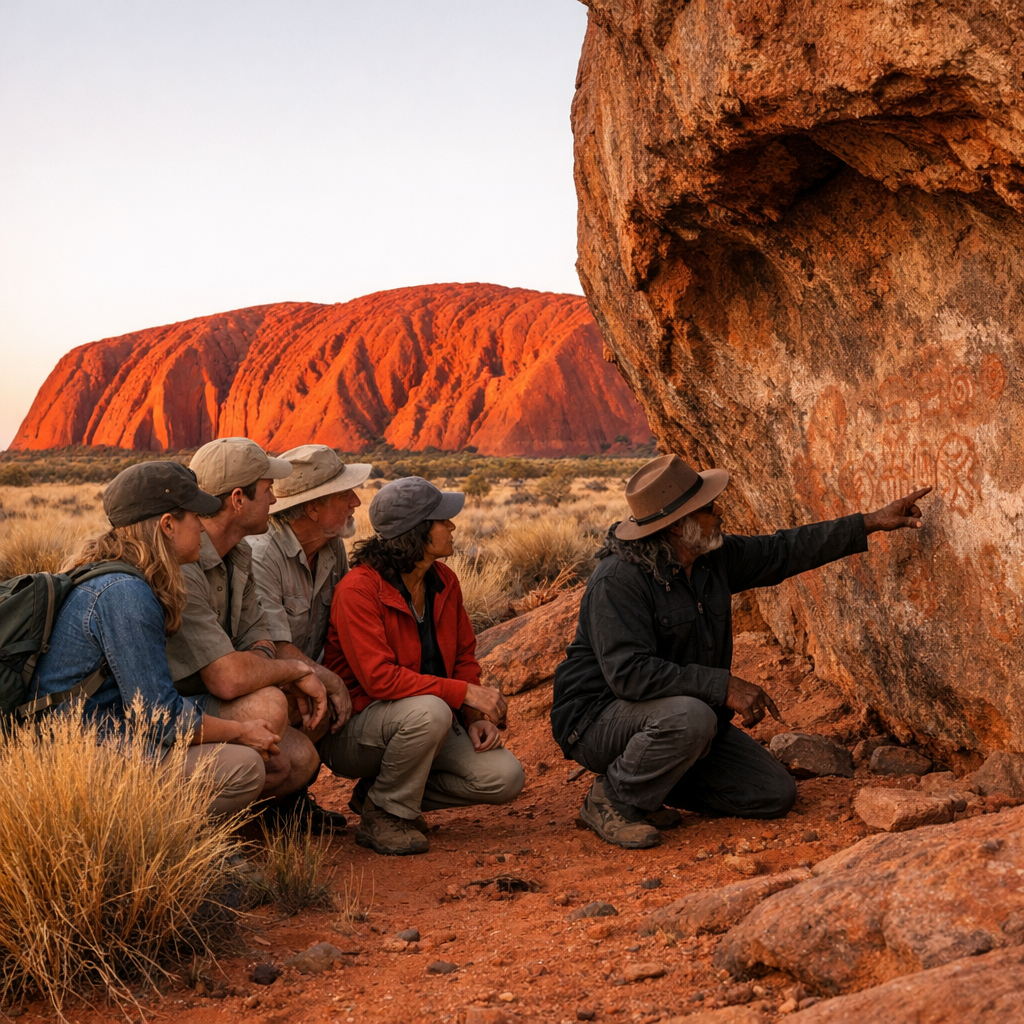
Uluru — the enormous red sandstone monolith rising from the desert in the Northern Territory — is the traditional land of the Aṉangu, the Pitjantjatjara and Yankunytjatjara Aboriginal people who have lived in and cared for this country for tens of thousands of years. In 1985, the Australian government formally handed ownership of Uluru back to the Aṉangu, who now jointly manage Uluru-Kata Tjuta National Park alongside Parks Australia.
For decades, tourists climbed the rock over the objections of the Aṉangu, who consider the climbing route a sacred Tjukurpa (Dreamtime) pathway and who repeatedly, publicly asked visitors not to climb — for spiritual reasons and because the climb was genuinely dangerous, claiming numerous lives over the years. In 2017, the park's board voted unanimously to close the climb permanently. The ban took effect on October 26, 2019 — the 34th anniversary of the land handback — and the safety chains bolted into the rock were removed at the same time. Climbing Uluru is no longer possible, and BTN wants to be explicit about this: do not go looking for a workaround, and do not treat the ban as a loophole or a dare. Respecting it is the price of admission to one of the most spiritually significant places on Earth.
The good news is that not climbing Uluru does not mean missing out. It means experiencing it the way the Aṉangu have always intended — on foot, at eye level, learning the stories instead of walking over them.
Walking With the Traditional Owners: Aboriginal-Led Experiences
The single best thing a Black traveler can do at Uluru is book time with Aṉangu-led or Aboriginal-owned operators rather than generic outback tour buses. A few worth prioritizing:
- Maruku Arts — An Aṉangu-owned arts collective based at the Uluru-Kata Tjuta Cultural Centre, representing dozens of Aboriginal artists from communities across Central Australia. Their dot-painting and wood-carving (punu) workshops are led by Aṉangu artists and are one of the only ways to bring home art with a direct, transparent line back to the people who made it.
- SEIT Outback Australia — Operates under agreement with Aṉangu traditional owners to run guided base walks and cultural tours featuring Aṉangu guides who share Tjukurpa stories, bush food knowledge, and rock art interpretation directly at the base of Uluru.
- Karrke Aboriginal Cultural Experience — A family-run, Aboriginal-owned cultural tour operating out of the Watarrka (Kings Canyon) region near Uluru, offering bush tucker demonstrations, traditional tool-making, and storytelling led by the family that owns and runs it.
- Uluru-Kata Tjuta Cultural Centre — Not a commercial tour but essential and free: exhibits, Tjukurpa stories the Aṉangu have chosen to share publicly, and the starting point for understanding what you're about to see before you see it.
Book directly or through the Ayers Rock Resort concierge, and confirm current operator status before travel, since remote Indigenous tourism ventures can change hours seasonally.
Sydney's Aboriginal Story: Beyond the Harbour Bridge
Sydney's postcard skyline sits on the traditional land of the Gadigal people of the Eora Nation, and the city's Aboriginal history runs far deeper than most visitors ever learn. Dreamtime Southern X, an Aboriginal-owned tour operator, runs some of the most respected Aboriginal-led experiences in the city, including guided walks through The Rocks that reframe the harbourfront through Aboriginal eyes — pointing out middens, sacred sites, and colonial flashpoints hidden in plain sight among the sandstone warehouses and tourist shops.
Redfern, a neighborhood a short train ride from the CBD, is the historic heart of urban Aboriginal political organizing in Australia — home to the Aboriginal Tent Embassy movement's city cousins, the National Black Theatre, and decades of grassroots activism. It is also, not coincidentally, where Charles Perkins lived and organized during his student years. A respectful visit here, ideally guided, connects the dots between the 1965 Freedom Ride and the ongoing fight for Aboriginal rights today.
NAIDOC Week: Time Your Trip Around Culture
If you can build your trip around it, NAIDOC Week — Australia's largest annual celebration of Aboriginal and Torres Strait Islander history, culture, and achievements — is typically held in the first full week of July and includes concerts, marches, art markets, family days, and community events in every major city, including Sydney and Alice Springs (the gateway town near Uluru). It's an unmatched opportunity to experience Aboriginal culture as a living, celebratory, present-tense thing rather than only through museums and monuments. Confirm exact dates for the year you're traveling, since they shift slightly year to year.
Getting There & Visa Requirements
US citizens need an Electronic Travel Authority (ETA, subclass 601) to enter Australia — there is no visa-on-arrival and no visa-free entry for US passport holders. The ETA is applied for entirely online (or via the Australian ETA mobile app) before you fly, costs roughly $20 AUD, and typically processes within minutes to a few days. It allows multiple entries over 12 months, with stays of up to three months per visit. Apply at least a few days before departure and double-check your passport details match exactly — mismatches are the most common cause of delay.
Most US flights route through Sydney (SYD) on Qantas, United, or Delta — expect 14-17 hours in the air. From Sydney, it's roughly a 3.5-hour domestic flight to Ayers Rock Airport (AYQ), the gateway to Uluru and the resort town of Yulara.
✈️ Find Flights to Australia →Getting Around
In Sydney, the Opal card covers trains, buses, ferries, and light rail, and the CBD, Rocks, and harbour precincts are very walkable. Around Uluru, virtually all visitors base themselves in Yulara at Ayers Rock Resort, which runs a free shuttle to the park entrance; a rental car adds flexibility for sunrise/sunset viewing, but guided tours led by Aṉangu are the better choice for context over just photos.
Best Time to Visit
May through September is the sweet spot for Uluru — the desert's cooler dry season, with daytime temperatures in the comfortable 65-77°F range instead of summer's brutal 100°F+ heat. Sydney is genuinely pleasant nearly year-round, though September-November (spring) and March-May (autumn) avoid both summer crowds and winter chill.
Budget Guide
Budget: $100-150/day — hostel or budget motel, self-catering or food-court meals, free walking tours and cultural centre visits, public transit.
Mid-range: $200-350/day — mid-tier hotel at Ayers Rock Resort or a Sydney harbour-adjacent hotel, one guided Aṉangu tour or cultural experience per day, restaurant dining.
Luxury: $500+/day — Longitude 131° (Uluru's ultra-luxury desert camp) or a Sydney Harbour five-star property, private guided cultural tours, fine dining.
BTN Insider Tips
Don't ask about "climbing" Uluru. It's banned, it's not coming back, and Aṉangu guides have heard every version of "is there a way around it" — there isn't, and asking undercuts the respect the whole trip is built on.
Book Aṉangu-led experiences first, fill the schedule around them. Generic coach tours are everywhere; time with actual traditional owners and Aboriginal-owned operators is limited and worth prioritizing.
Visit the Cultural Centre before you see the rock up close. The context changes everything about how you experience the base walk.
Sunrise and sunset at Uluru are not interchangeable. The rock's color shift at both ends of the day is dramatically different — if you only have one trip, ask your accommodation which is better for current season and weather.
In Sydney, take a guided Aboriginal history walk before doing anything else touristy. It recontextualizes the Opera House, the Harbour Bridge, and The Rocks for the rest of your stay.
Is Australia Safe for Black Travelers?
Australia is generally very safe for international visitors, with low violent crime in both Sydney and the Uluru tourism zone. That said, Black travelers have reported occasional racial profiling in some regional areas — echoing exactly the dynamics the 1965 Freedom Riders exposed. Sydney's diversity makes it broadly comfortable; regional Australia can feel different. Standard precautions apply, and connecting with Aboriginal-owned operators and diaspora networks is the best source of current, grounded safety context.
Mark Your Calendar
- Early July — NAIDOC Week, held nationwide with major events in Sydney and Alice Springs
- January 26 — Australia Day / Invasion Day, marked by significant Aboriginal-led rallies and "Survival Day" events in Sydney
- May 26 — National Sorrow Day, part of National Reconciliation Week (May 27-June 3)
- October 26 — Anniversary of the 1985 Uluru land handback to the Aṉangu and the 2019 climbing ban
Book Your Australia Trip
Uluru and Sydney will give you the postcard. Charles Perkins, the Aṉangu, and the Freedom Riders will give you the story underneath it — and that story is the one worth carrying home.
✈️ Book Your Australia Trip Now →*Affiliate links — BTN may earn a commission at no extra cost to you.