A Pilgrimage, Not Just a Cruise
Some voyages are measured in miles and ports of call. This one is measured in something heavier. The West Africa Heritage Voyage traces the coastline where millions of Africans were held, sold, and forced through fortress doors onto ships bound for the Americas and the Caribbean — the same waters, the same castles, the same stone dungeons. For African diaspora travelers, sailing this route isn't a sightseeing itinerary. It's a pilgrimage to the source, in the spirit of Ghana's landmark 2019 "Year of Return," which marked 400 years since the first enslaved Africans arrived at Point Comfort, Virginia, in 1619 and drew hundreds of thousands of diaspora visitors back to Ghana's coast.
The confirmed 2026 sailing of this itinerary is Swan Hellenic's Atlantic Crossroads expedition cruise aboard the purpose-built polar-class ship SH Diana, running September 16–29, 2026 — 13 nights, 9 ports, 7 countries. One correction worth noting up front: while this route is often discussed in the Ghana-to-Senegal direction, the currently confirmed 2026 departure actually sails the reverse way, embarking in Dakar, Senegal and disembarking in Tema (Accra), Ghana. Swan Hellenic's SH Diana continues south from there into a separate West Africa-to-Angola sailing at the end of September, so travelers wanting the Ghana-to-Senegal direction specifically should confirm current-season routing directly with the operator, as expedition itineraries like this one do shift by season.
Elmina Castle and the Door of No Return
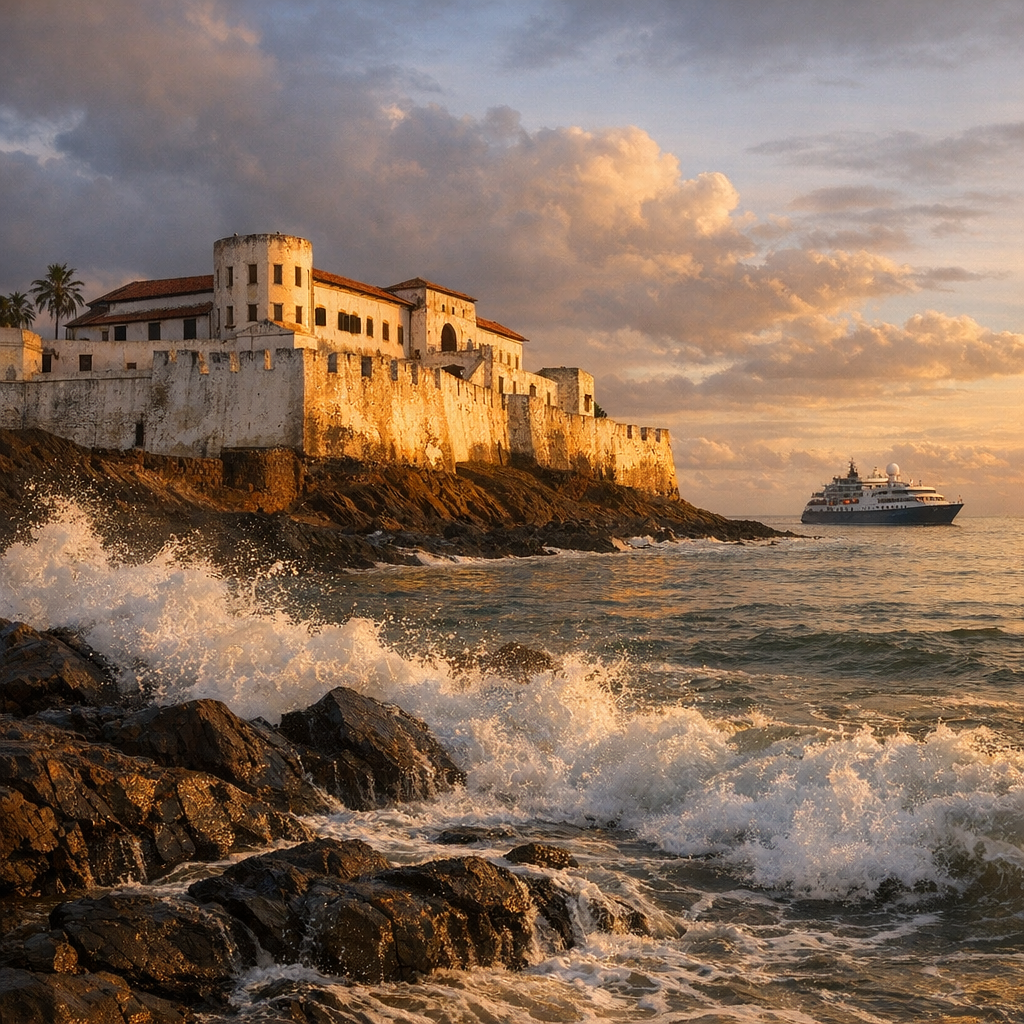
The emotional center of this journey is Elmina, Ghana. Built by the Portuguese in 1482 as São Jorge da Mina, Elmina Castle is the oldest surviving European-built structure in sub-Saharan Africa — and one of the most consequential. Seized by the Dutch in 1637 and later held by the British, it operated for centuries as a fortified trading post that became a central node in the transatlantic slave trade. Beneath its whitewashed walls are the dungeons where captured men and women were held in brutal, overcrowded conditions before being marched through a narrow stone threshold to the shore: the Door of No Return. For those who passed through it, it was, in almost every case, the last time they would ever see African soil.
Roughly a dozen kilometers away sits Cape Coast Castle, Elmina's sister fortress and fellow UNESCO World Heritage Site, which held its own "Door of No Return" and its own dungeons beneath a working British colonial administrative complex above. Together, Elmina and Cape Coast form the two most visited and most solemn sites on Ghana's slave coast — the sites that anchored the Year of Return and that continue to draw diaspora travelers seeking to stand, physically, where their ancestors' final African footsteps may have been taken. Many voyages pair a castle visit with an excursion to nearby Kakum National Park, home to a rainforest canopy walkway, offering a moment of the natural world's continuity after the weight of the castle tour.
The Full Itinerary: Nine Ports, Seven Countries
What makes this expedition remarkable is how many other layers of diaspora and colonial history it strings together along the same coastline:
- Dakar, Senegal (Days 1–2): Senegal's vibrant capital, with its markets and colonial architecture, and an optional excursion to Gorée Island, the UNESCO World Heritage Site whose House of Slaves and its own Door of No Return made it one of the most symbolically significant sites of the Atlantic slave trade.
- Banjul, The Gambia (Day 3): The compact colonial capital at the mouth of the Gambia River, with cultural performances and traditional markets.
- Bijagós Archipelago, Guinea-Bissau (Days 4–5): A UNESCO Biosphere Reserve of 88 islands, largely untouched by mass tourism, home to rare wildlife and traditional island communities living much as they have for generations.
- Freetown, Sierra Leone (Day 7): Home to the Cotton Tree, the symbolic heart of the city where freed and formerly enslaved settlers gathered in 1792 after being resettled from Nova Scotia and Britain. Optional excursions visit Bunce Island, a former British slave castle further up the river, and the Tacugama Chimpanzee Sanctuary.
- Monrovia, Liberia (Day 9): Founded in 1822 by freed African Americans and free-born Black settlers under the American Colonization Society, with historic sites tied to Americo-Liberian heritage, including Providence Island.
- Abidjan, Cote d'Ivoire (Day 11): A stop in the country's cultural and economic hub, with an excursion to the UNESCO-listed colonial district of Grand-Bassam.
- Takoradi and Elmina, Ghana (Day 12–13): Takoradi's working port and colonial-era fort, followed by Elmina Castle and the Door of No Return, with an optional Kakum National Park canopy walk.
- Tema (Accra), Ghana (Day 14): Disembarkation in Ghana's modern capital, with time to explore the historic Jamestown neighborhood.
Life Aboard SH Diana
SH Diana is a small, purpose-built expedition ship — nothing like the mega-ships that dominate Caribbean group cruising. Staterooms range from 20-square-meter Oceanview cabins up through Balcony, Junior Suite, Suite, and Premium Suite categories (the largest suites include private balconies, fireplaces, and walk-in wardrobes). With a shallow enough draft and small enough footprint to access the archipelagos and river mouths that larger ships can't reach, the ship itself is built for exactly this kind of expedition itinerary — expert onboard lecturers, Zodiac landings where there's no pier, and a genuinely immersive rather than resort-style pace. Days at sea between ports are used for onboard lectures on West African history, culture, and ecology, which matters enormously on a route this historically dense; the context shapes how you experience each stop.
Booking and Pricing
Swan Hellenic does not publish flat per-person fares for this sailing online — every stateroom category on the Atlantic Crossroads itinerary is currently listed as price on request, which is standard for small-ship luxury expedition cruising. Interested travelers should request a quote directly through Swan Hellenic (1-800-537-6777) or a travel advisor who books expedition cruises, and should ask specifically about single-supplement policies, included shore excursions versus optional paid excursions (Gorée Island, Bunce Island, and Kakum National Park are typically optional add-ons), and what's included in the fare (gratuities, house beverages, and expedition gear are bundled on many Swan Hellenic sailings, but confirm before booking). Given the depth of the itinerary and the small-ship model, expect this to price well above a mainstream Caribbean cruise — budget accordingly and book early, as expedition-class West Africa sailings run limited departures per year and cabins are finite.
Why This Journey Matters
There is a particular kind of travel that asks something of you beyond relaxation. This is that kind of trip. Walking through the Door of No Return at Elmina or Cape Coast, standing on Gorée Island, or hearing the history of Freetown's Cotton Tree and Monrovia's founding isn't comfortable, and it isn't supposed to be. But for many in the African diaspora, it is also profoundly clarifying — a chance to trace, in physical space, the beginning of a story that continues in Black communities across the Americas, the Caribbean, and Europe today. Ghana's Year of Return proved the appetite for this kind of ancestral travel is real and growing; a full expedition cruise along this coast, rather than a single-country visit, lets travelers see the wider geography of the trade and the resilience of the communities that formed in its wake, from Freetown's freed settlers to Liberia's Americo-Liberian founders.
This is not a party cruise, and it shouldn't be marketed like one. It's a chance to hold grief, ancestry, and history in the same week as genuine natural beauty (the Bijagós Islands, Kakum's rainforest canopy) and vibrant contemporary West African culture. For anyone who has felt the pull to "go back" in a way no ordinary vacation satisfies, this itinerary is one of the most complete ways to do it.
BTN Insider Tips
Confirm direction and dates before booking. Expedition itineraries along this coast run seasonally and the direction (Ghana-to-Senegal vs. Senegal-to-Ghana) can flip between sailings — verify the exact 2026 or 2027 departure and route with Swan Hellenic before finalizing plans.
Prioritize the castle visits, don't rush them. Whether it's Elmina, Cape Coast, or Gorée Island, give yourself time in the dungeons and at the Door of No Return. Many travelers say the visit needs quiet processing time afterward — don't overschedule the rest of that day.
Pack for expedition landings, not resort lounging. Zodiac landings at places like the Bijagós Islands and river-mouth ports mean sturdy shoes and quick-dry clothing matter more than resort wear.
Ask about single-supplement and inclusions upfront. With no published pricing, get a full written quote covering gratuities, excursions, and any single-traveler surcharge before booking.
BTN's Verdict
This is one of the most historically significant itineraries in modern cruising, full stop. It won't suit every traveler — it's not designed to — but for diaspora travelers seeking a heritage pilgrimage with the logistics of an expedition cruise handled for them, the combination of Elmina's Door of No Return, Gorée Island, Freetown's Cotton Tree, Liberia's Americo-Liberian history, and the untouched Bijagós Islands is unmatched by any single-country trip. Confirm your dates, budget for a premium small-ship fare, and go in ready for a week that will ask something of you emotionally — and give something back in return.
Check Availability with Swan Hellenic →Book Flights to Dakar or Accra →*Some links on this page are affiliate links — Black Travel Now may earn a commission at no extra cost to you.